








How Can You Stop A Factory In Your Neighborhood From Mismanaging Its Waste In India?
Quick Answer:
A factory occupier is legally responsible for safe and environmentally sound waste management of every kind of waste generated by the unit.
(Rule 4(2) of the Hazardous and Other Wastes (Management and Transboundary Movement) Rules, 2016, enacted under the framework of the Environment (Protection) Act, 1986.)
So, if a factory fails to do so or it runs without valid authorization, consent, or records, you can file a complaint before the State Pollution Control Board.
You can even escalate the matter to the Central Pollution Control Board and approach the
National Green Tribunal for relief.
Why Is This Illegal? Quick Reference Table
A factory cannot write its own waste rules.
Also, these are the most common lapses in factory waste management and the provisions they break.
| Violation | Why It Is Illegal | Provision |
|---|---|---|
| Operating without Consent to Establish or Operate | Effluent and emissions need prior consent from the State Board | Water Act 1974, s.25Air Act 1981, s.21 |
| Handling hazardous waste without authorisation | Occupiers handling such waste must hold authorisation | HOWM Rules 2016, Rule 6 |
| Unlabelled or leaking storage | Storage, packaging and labelling standards are mandatory | HOWM Rules 2016, Rules 8 and 17 |
| Giving waste to unauthorised dealers | Waste goes only to authorised users or disposal facilities | HOWM Rules 2016, Rule 4(3) |
| Pollutants beyond prescribed standards | Standards apply to every industry | Environment (Protection) Act 1986, s.7 |
| No segregation at bulk volumes | Bulk generators must segregate into four streams and process responsibly. | SWM Rules 2026 |
Despite so many rules regarding factory waste management, the enforcement is not that strict.
Also, in many cases, we fail to file a specific complaint against factory waste management.
Governing Law And Your Legal Rights

The laws and legal provisions against factory waste mismanagement come from the Environmental Protection Law of 1986.
Here is what this rule defines as the environment.
“Environment includes water, air and land and the interrelationship which exists among and between air, water and land and human beings, other living creatures, plants, micro-organisms and property.”
Here is more about legal provisions to stop factory waste mismanagement in India.
Key Laws That Apply
There are four main legal instruments to stop malpractices in factory waste management in India.
- The umbrella law is the Environment (Protection) Act, 1986.
- Then, the Water Act, 1974, and the Air Act, 1981, control consent.
- Again, the occupier is responsible for factory waste management under the Other Wastes (Management and Transboundary Movement) Rules, 2016, notified on 4 April 2016.
- The Solid Waste Management (SWM) Rules, 2026, in force since 1 April 2026, pull large industrial units into a bulk-generator regime.
Here, I want to clarify one distinction.
Hazardous waste sits under the 2016 Rules, while non-hazardous solid waste from bulk generators falls under the 2026 Rules.
Furthermore, there will be an additional legal layer with the State Boards attaching conditions to every consent order.
The State Boards also add conditions to effluent treatment, stack limits, and waste storage.
All these conditions are legally enforceable.
Your Rights As A Citizen
- The Supreme Court of India has read the right to a clean environment into Article 21 of the Constitution.
“Article 21 guarantees the fundamental right to life.
The right to an environment, free of the danger of disease and infection, is inherent in it.
The right to a healthy environment is an important attribute of the right to live with human dignity.
The right to live in a healthy environment as part of Article 21 of the Constitution was first recognized in the case of Rural Litigation and Entitlement Kendra vs. State, AIR 1988 SC 2187 (Popularly known as the Dehradun Quarrying Case).
It is the first case of this kind in India, involving issues relating to environment and ecological balance in which the Supreme Court directed to stop the excavation (illegal mining) under the Environment (Protection) Act, 1986.”
(Source: Press Information Bureau, Government of India)
- It is the fundamental duty of every citizen to protect the environment.
“It shall be the duty of every citizen of India to protect and improve the natural environment including forests, lakes, rivers and wildlife and to have compassion for living creatures.”
Article 51-A (g), The Constitution of India.
- You have the right to file a complaint before the State Board, CPCB and the adjudicating officer under the Environment (Protection) Act.
- The right to seek consent and authorisation records through the Right to Information Act, 2005.
“The right to information is implicitly guaranteed by the Constitution.
However, with a view to set out a practical regime for securing information, theIndian Parliament enacted the RIGHT TO Information Act, 2005 and thus gave apowerful tool to the citizens to get information from the Government as a matter ofright.
This law is very comprehensive and covers almost all matters of governanceand has the widest possible reach, being applicable to Government at all levels, Union, State and Local as well as recipients of government grants.”
- The right to seek relief, compensation and restoration from the National Green Tribunal under the NGT Act, 2010.
Penalties And Consequences
Here, the Jan Vishwas (Amendment of Provisions) Act, 2023 is the basis.
Most contraventions of the Environment (Protection) Act draw monetary penalties between ₹10,000 and ₹15 lakh, decided by an adjudicating officer of at least Joint Secretary rank.
That penalty sits on top of any compensation the NGT orders.
Boards can also issue directions, including closure and stopping of power or water.
Removing jail terms made enforcement faster on paper, but it only bites when citizens file complaints that name the exact provision broken.
Where To Complain For Factory Waste Management?
| Authority | What it does | Approach when |
|---|---|---|
| State Pollution Control Board (Regional Office) | Grants consent, inspects, samples, and issues directions | First complaint, and any time you need inspection. |
| CPCB | Sets standards and oversees Boards | The Board is silent, or the violator is a large unit. |
| MoEFCC and CPGRAMS | Policy, rule-making and grievance tracking | Escalation after about 30 days of inaction. |
| Adjudicating officer, Environment (Protection) Act | Hears complaints and imposes penalties | You want a monetary penalty imposed. |
| National Green Tribunal | Orders stoppage, compensation, and restoration | Harm is ongoing, or authorities have not acted. |
Step-By-Step Action Plan To Stop The Violation Of Factory Waste Management
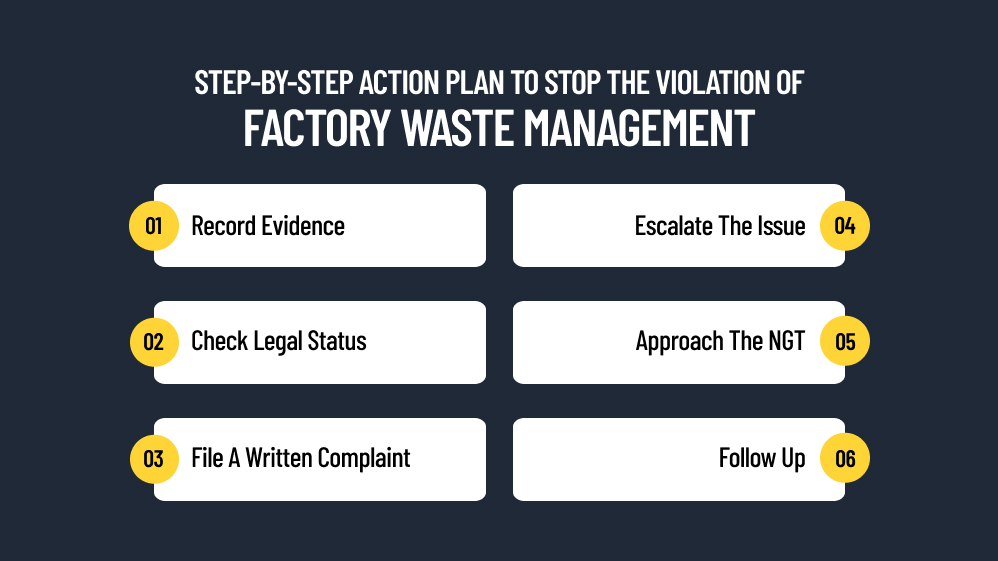
Follow this sequence to stop violations of factory waste management.
Also, there is a complaint template at the end of this article.
You can download the template and fill it in to file the complaint.
| Action Step | Details and Protocol |
|---|---|
| Record Evidence | • Take dated photos or videos from public land. • Note the factory name and exact location. • Document vehicle numbers and specific times. • Never enter the premises. |
| Check Legal Status | • Ask the Regional Office of the State Pollution Control Board if the unit holds valid consent and authorisation. • File an RTI application if the authorities refuse to share details. |
| File a Written Complaint | • Address the official complaint directly to the Member Secretary of the State Board. • Cite the exact environmental rule broken. • Insist on receiving a stamped acknowledgement for your records. |
| Escalate the Issue | • Wait for 30 days before escalating the matter. • Write directly to the CPCB and the Ministry of Environment, Forest and Climate Change. • Lodge an official grievance on the CPGRAMS portal. |
| Approach the NGT | • File the official case within six months of the cause of action. • Attach all collected evidence and your complete prior complaint trail. • Argue the case in person or hire a lawyer to represent you. |
| Follow Up | • Use the RTI tool to request copies of official inspection reports. • Obtain the official action taken report from the board. |
However, if you notice any imminent and destructive danger such as fire, explosion, or toxic release, you must call 112 first and then lodge a complaint.
What Counts As Strong Evidence
- Dated photos and videos with a visible location marker.
- Vehicle numbers, loading times and the name of the unit.
- Copies of complaints, acknowledgements and replies.
- RTI responses showing consent, authorisation or inspection reports.
Mistakes To Avoid While Filing A Complaint Against Waste Mismanagement
- Complaining without naming the unit or location, which stalls inspection.
- Relying on verbal assurances instead of a stamped acknowledgement.
- Waiting beyond six months and losing the NGT route.
Factory waste problems rarely fix themselves.
Boards are stretched thin, and a precise, documented complaint is often what moves a file from the bottom of the pile to the top of the inspection list.
Factory Waste Management: Frequently Asked Questions (FAQs)
Here are the frequently asked questions and answers to factory waste mismanagement.
1. Can An Ordinary Resident File A Complaint?
Yes, every citizen can complain against factory waste mismanagement to the State Board or the Central Board of Pollution.
Also, at the National Green Tribunal, you must show how the environmental violation is affecting your surroundings.
2. Is The Factory Owner Still Liable If A Contractor Handles Its Waste?
Yes, the factory owner is still liable if a contractor handles its waste and mismanages it.
The statutory provision here is Rule 4(2) of the Hazardous and Other Wastes (Management and Transboundary Movement) Rules, 2016, enacted under the framework of the Environment (Protection) Act, 1986.
3. Is There A Time Limit For Approaching The NGT?
Yes, there is a time limit for approaching the NGT.
It is six months from the cause of action, extendable by up to 60 days for sufficient cause.
4. Can I Complain Anonymously?
The provision for anonymity varies by board.
However, the pollution boards will take a named complaint with evidence more seriously.
So, ask whether confidentiality is available.
5. Can The Board Shut A Factory Down?
The Board can recommend or issue orders, including closure, under Section 33A of the Water (Prevention and Control of Pollution) Act, 1974.
The other provisions are Section 31A of the Air (Prevention and Control of Pollution) Act, 1981, and Section 5 of the Environment (Protection) Act, 1986
6. What Evidence Is Strongest?
Dated visuals, vehicle numbers, and Board records showing missing consent or authorisation are the strongest evidence.
You can also do water sampling that shows normal pollutant levels upstream from the factory but a sudden, massive spike immediately downstream from its discharge points.
7. Does A Small Factory Have The Same Duties?
Yes, a small factory has the same duties if it needs consent or holds hazardous waste.
However, with the type and quantity of the waste, duties will scale.
Downloadable Complaint Letter Template
Fill in the bracketed fields, attach evidence, and submit with a stamped acknowledgement.
To: The Member Secretary, [State] Pollution Control Board, [Address]
Copy to: The Regional Officer, [Region], Central Pollution Control Board, Delhi
Subject: Complaint against illegal factory waste management by [Factory name], [Address]
Respected Sir/Madam,
I wish to report that [Factory name], located at [Address], is engaged in storing, moving, or discarding waste without valid consent, authorisation, or records.
On [dates and times], I observed [describe what you saw]. Dated photographs, video, and a location pin are attached.
This conduct appears to violate the Environment (Protection) Act, 1986, the Water Act, 1974, the Air Act, 1981, and the Hazardous and Other Wastes (Management and Transboundary Movement) Rules, 2016.
I request (1) an urgent inspection and, where relevant, sampling, (2) verification of the unit’s consent and authorisation, (3) action under the applicable laws, and (4) an acknowledgement and an action-taken report.
Yours sincerely,
[Name] | [Address] | [Phone] | [Email] | [Date]
Enclosures: photographs, video, location pin, vehicle numbers, earlier correspondence.