


How To Play Camel Up: Rules, Scoring, Strategy And Why This Spiel Des Jahres Winner Still Leaves Rivals In The Dust
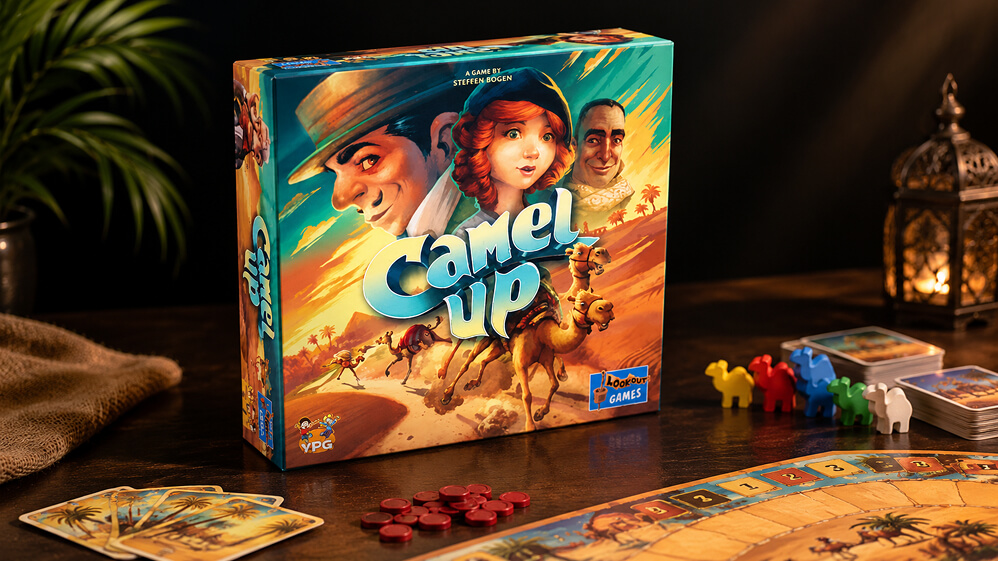
Camel Up is a betting game, and it is for three to eight players.
The players in this game wager Egyptian Pounds on a camel race.
Furthermore, in this game, the camels stack, hitch rides on each other, and sometimes run backwards.
When you get your turn in the game, you can do one of these four activities.
- Take a leg betting tile.
- Then, take a pyramid tile.
- Next, roll a die to move a camel.
- Then, place a spectator tile, or you can secretly bet on the overall winner or loser.
The first camel across the finish line will end the race, and the richest player will win the game.
This is how the entire game proceeds, and the crooked part of it is why it works.
Your family watches you being wrong while betting on the camel, and they enjoy every second of it.
Hi, in today’s blog, I will discuss how to play Camel Up game, the scoring maths, the strategy that works, and the history behind it.
The Camel Up Game: Quick Facts
| Detail | Camel Up (Second Edition) |
|---|---|
| Designer | Steffen BogenArt by Dennis Lohausen and Chris Quilliams |
| Publisher | Eggertspiele and Pegasus SpielePlan B Games for English-language editions |
| Players | 3 to 8One retailer lists 5 to 6 as the sweet spot |
| Play time | 30 to 45 minutes |
| Age | 8 and upNo reading required, and scoring needs only double-digit addition. |
| Award | 2014 Spiel des Jahres winner |
Camel Up History: From A Dice Machine To A Spiel Des Jahres
Camel Up started with a gadget and not a theme.
Steffen Bogen began building a game around a dice-dispensing machine he had invented back in 2006.
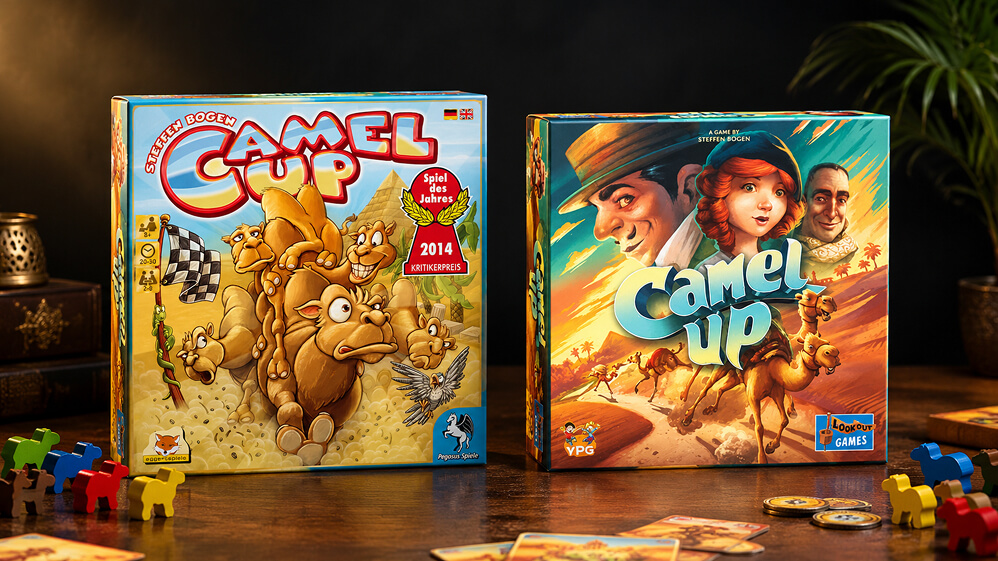
Eggertspiele and Pegasus Spiele released the finished game in early 2014.
It was nominated for the Spiel des Jahres that May alongside Splendor and Concept, and it took the prize.
A light family betting game had outranked two heavily fancied rivals.
The Camel Cup Mix-Up
There is a long-standing board game joke that the game was supposed to be called “Camel Cup.”
Bogen himself has acknowledged that the idea was indeed to build “Camel Cup.”
Because the camels stack on each other, the publishers came up with the new name.
Second Edition, Supercup And Off Season
In 2015, we got a Supercup expansion of up to 10 players and a mobile app.
In 2018, a revised second edition made its debut at Essen.
Furthermore, in the new edition, a plastic pyramid took the place of the original cardboard dice tower.
Also, there were engraved dice and rogue camels that ran the opposite way.
Moreover, the US launch price was $40.
A spinoff, Camel Up: Off Season, arrived in 2021 and swaps racing for push-your-luck caravan stacking.
My own conjecture is that the “Egyptian high society” theme borrows the old pith-helmet appetite for desert glamour.
It is window dressing, and the game is better for not taking it seriously.
| Feature | Original (2014) | Second Edition (2018) |
|---|---|---|
| Players | 2 to 8 | 3 to 8 |
| Dice dispenser | Cardboard dice tower | Plastic pyramid with button, engraved dice |
| Crazy camels | No | Yes, two camels running in reverse |
| Partnership mode | No | Yes, with 6 or more players |
| Track tiles | Oasis and mirage desert tiles | Double-sided spectator tiles (+1 and -1) |
What Is In The Box And How To Set Up Camel Up?
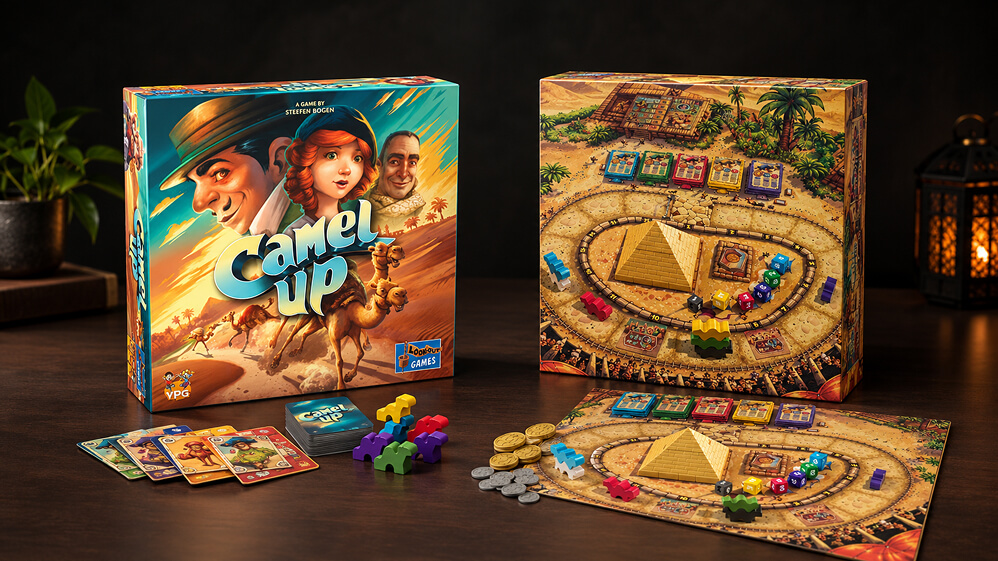
You can set up the game in just five minutes.
Also, the things you need to set up are:
- Board and Pyramid
- Five Racing Camels
- Two Crazy Camels
- Colored Betting Tiles
- Coins
- Player Cards
Follow this step-by-step guide to set up the game.
1. Place the board in the centre of the table.
Sort the leg betting tiles by colour on the ticket tents near the start line, with the 2 tile at the bottom, the 3 above it, and the 5 on top.
2. Stack the five pyramid tiles in their space and put the coins (Egyptian Pounds, or EP, in 1s and 5s) within everyone’s reach.
3. Give each player 3 EP, their five finish cards, and one spectator tile.
With 6 or more players, also hand out a partnership card.
4. Roll all the coloured dice.
Each racing camel starts on the space matching its roll (1, 2 or 3).
Camels that share a space are stacked randomly.
5. Roll the grey die once for each crazy camel.
A 1 places it on space 16, a 2 on space 15, and a 3 on space 14.
Racing camels face clockwise, crazy camels anticlockwise.
6. Give the starting player marker to the youngest player.
How To Play Camel Up: The Four Actions
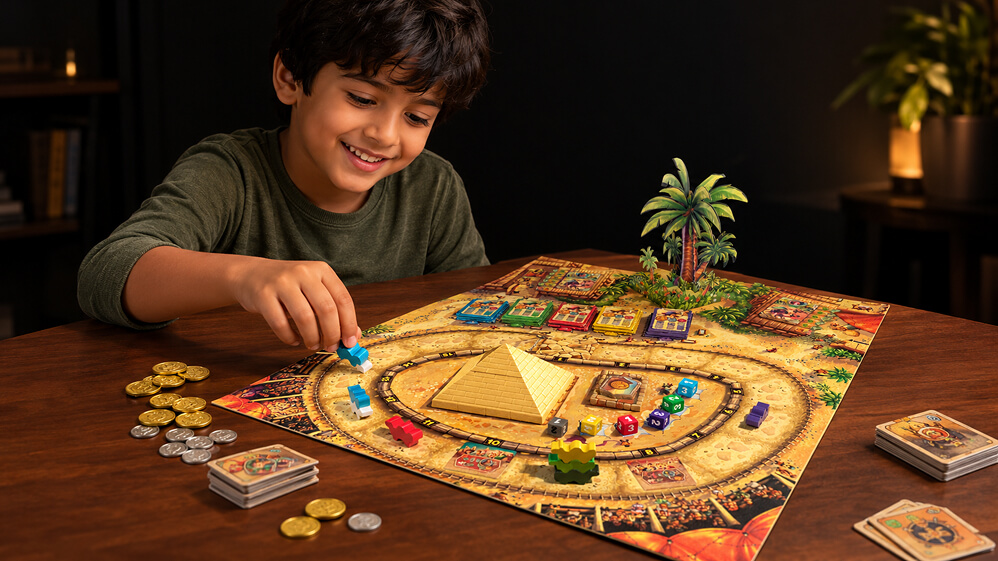
The race of the Camel Up game is broken into legs.
A leg ends when five of the six pyramid dice have been rolled.
The most important thing to understand is that leg bets are about who leads at the end of the leg, not who wins the race.
Action 1: Take A Leg Betting Tile
This is your main money action. Take the top tile from the stack of the camel you think will lead at the end of the leg.
You may take one per turn, and you can hold several, even in the same colour.
The stack runs 5, 3, 2 from top to bottom, so early bettors earn more.
Action 2: Place Your Spectator Tile
Put your tile on any space except space 1, and never next to another spectator tile.
The cheering side (green +1) pushes a camel unit forward a space and stacks it on top of whatever is there.
The booing side (red -1) sends it back a space and slides it underneath.
Whoever owns the tile collects 1 EP each time a camel lands on it, and the tile returns to them.
Action 3: Take A Pyramid Ticket And Roll
Take a pyramid ticket, shake the pyramid, and press the button.
The die that drops out shows which camel moves, and it moves the number shown.
Park that die on a dice tent. It stays out of the pyramid until the leg ends.
Each ticket pays a guaranteed 1 EP at the end of the leg, which makes this the safe option when every good bet is gone.
Action 4: Bet On The Overall Winner Or Loser
Pick one of your five finish cards, secretly, and place it face down on the winner or loser space.
You cannot take it back.
These bets score only when the race ends, and earlier cards pay more.
The Fifth Action: Partnerships (6+ Players)
With six or more players, you can swap partnership cards with anyone not already partnered that leg, and they cannot refuse.
At leg scoring, each partner may claim the winnings from one of the other’s betting tiles, though nobody is forced to take a loss.
How Camel Stacking And Crazy Camels Work
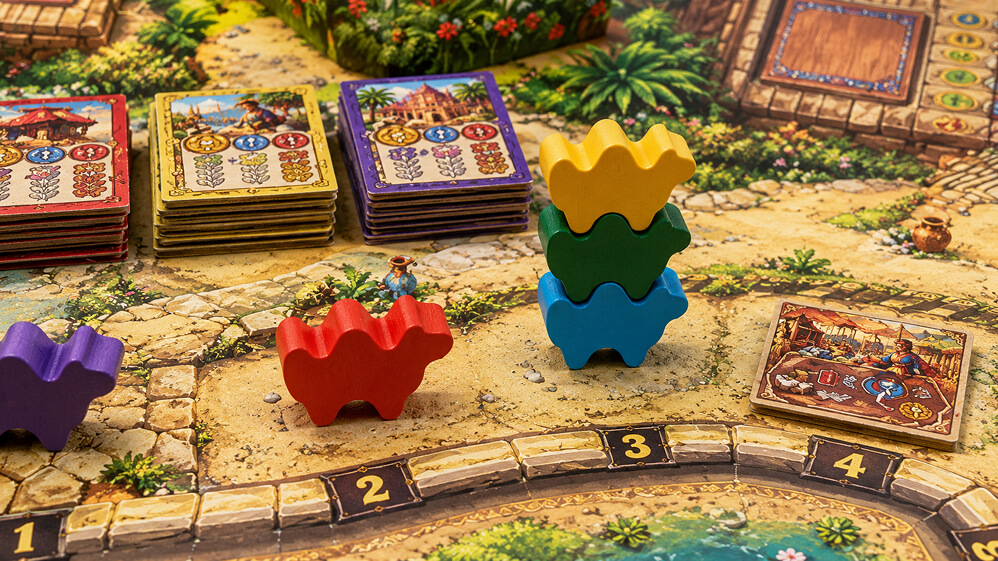
Everything surprising about Camel Up comes from the stacks.
So it is worth getting these rules straight before the first roll.
Camel Units
Camels sitting on each other form a “camel unit”.
When a camel moves, it carries every camel above it and leaves the ones below behind.
If a unit lands on an occupied space, it goes on top. In the standings, a camel above another is ahead of it.
Crazy Camels
When the grey die drops, the number is either white or black, and the crazy camel of that colour moves in the opposite direction.
There are two exceptions.
If only one crazy camel is carrying racing camels, that one moves regardless of colour.
If you stack the crazy camels with no racing camel between them, the top one moves.
Crazy camels are not counted in the rankings, but a racing camel riding one is dragged backwards, which is where bets go to die.
Ending A Leg And Scoring Camel Up
The leg ends when you take the fifth pyramid ticket and roll the die.
Then the clean-up runs in a fixed order.
- Pass the first player marker to the left of whoever took the last ticket.
- Check the standings of the racing camels (crazy camels are ignored).
- Resolve leg bets, then pay out or collect pyramid ticket income, all against the bank.
- Reset: tiles back to their slots in ascending order, spectator tiles to their owners, dice back in the pyramid.
| Bet | Payout |
|---|---|
| Leg tile on the leading camel | 5, 3, or 2 EP, depending on the value printed on your tile |
| Leg tile on the camel in 2nd | +1 EP |
| Leg tile on a camel in 3rd to 5th | -1 EP |
| Pyramid ticket | +1 EP each |
| Overall winner or loser card | 1st correct: 8 EP, then 5, 3, 2, 1 EP in order placed and wrong card: -1 EP |
End Of The Game
When any camel crosses the finish line, the Camel Up game ends.
Also, the official quick-tips sheet guides mention that the camel can cross the finishing line in any direction.
Score the final leg as normal, then flip the finish-card piles so the earliest card is on top and score the winner pile, then the loser pile.
The earliest correct card takes 8 EP, the next 5, then 3, 2, and 1, and every wrong card costs 1 EP.
Count your coins as the highest total wins.
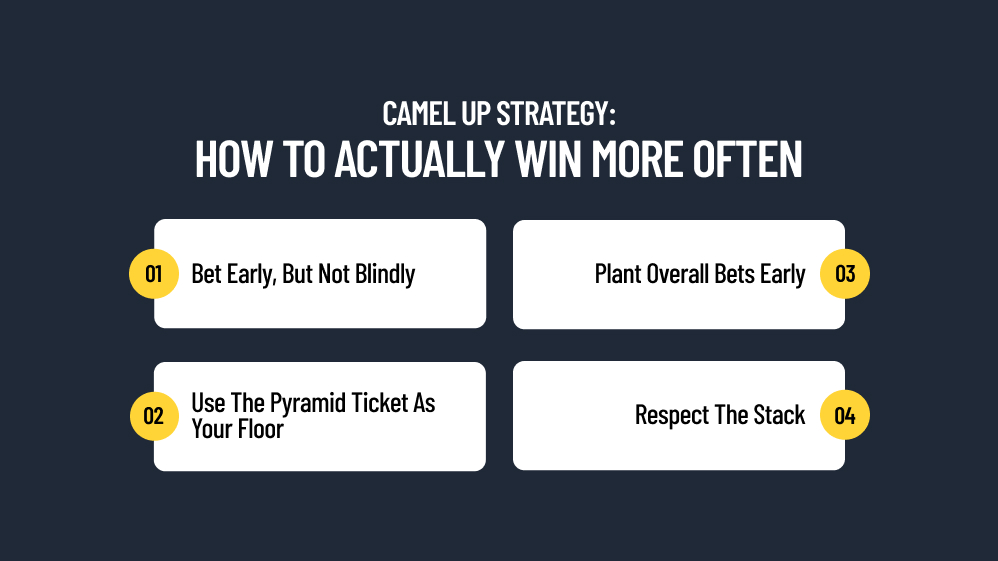
Camel Up Strategy: How To Actually Win More Often
Camel Up is luck-driven, and you have to be honest about it.
However, your skill level is tested at the betting layer.
Bogen himself has described two kinds of players: the probabilistic and the push-your-luck.
He also calculated the odds while designing the game.
These tips suit both.
Bet Early, But Not Blindly
The 5 tile is the prize for the game.
However, if you make the wrong guess, it can cost you 1 EP.
As a rule of thumb, you can grab the 5 only when you think the camel has better than a two-in-three chance.
Each rolled die leaves the pyramid, which makes the rest of the leg easier to predict, but by then the 5 tiles are usually gone.
Use The Pyramid Ticket As Your Floor
When all the good tiles are gone, a ticket guarantees 1 EP and burns a die, moving the leg toward scoring.
Rolling at the right moment can also shut rivals out of a bet they were planning.
Plant Overall Bets Early
An 8 EP payout is worth far more than a few leg tiles, and it only goes to the earliest correct card.
Some players like to commit early simply to have a stake in the race.
Remember the cards are final.
So spread your five across both piles instead of burying them all on the favourite.
Respect The Stack
A leader on top of a pile is vulnerable to a crazy camel, and a back-marker at the bottom of a stack can launch the whole unit forward.
Stack position matters more than track position.
Safety And Spend Callout
There are small camels, dice, tiles, and coins inside the box.
Also, as the label says, make sure that children below the age of 8 years do not get access to these pieces.
Furthermore, after playing a round of the game, you must count the dice back into the pyramid.
It is important because one missing die can break the leg count.
The second edition launched at $40 in the US, and UK retail listings currently run from roughly £31 to £43.
So check a price comparison before paying list price.