








How Can You Push Industries To Follow Waste Reduction Rules In India?
Fighting Against Industrial Waste Management: Quick Answer
In the Indian legal system, the laws regarding waste prevention and reduction take precedence over recycling and disposal.
The Solid Waste Management Rules, 2026 and the Hazardous Waste Rules, 2016 expect industries to minimise waste at source and reuse or recycle before disposing.
As a citizen, if you see any violation of proper industrial waste management, you can check consent conditions, request records, and complain to the State Pollution Control Board or NGT.
Why Is Industrial Waste Mismanagement Illegal? Quick Reference Table
Industrial waste management or waste reduction is beyond a slogan.
It is a step-by-step process, and every step carries a legal expectation.
| Waste Hierarchy Step | What the Unit Must Do | How You Can Check |
|---|---|---|
| Prevent and reduce | Cut waste at source and follow the hierarchy. | Ask for consent and clearance conditions. |
| Reuse and recycle | Send waste to authorised recyclers or users. | Verify the recipient’s authorisation. |
| Recover | Solid-fuel industries must substitute part of their fuel with RDF. | Request fuel-mix records. |
| Dispose last | Landfill or disposal only after other options. | Check manifests and facility receipts. |
Why This Keeps Happening
Industrial waste mismanagement sounds voluntary, and that is why it is often ignored.
However, the hierarchy of industrial waste management prioritizes prevention and reduction.
All the other steps are a fallback and not a starting point.
The lack of visibility in the process of waste management happens because the process takes place inside the plant.
Also, waste management is associated with the materials a factory uses and the processes it follows.
So, outsiders rarely get to see the major part of it.
That is why records, conditions, and public hearings matter more here than photographs.
Public information is your friend.
Clearance conditions, hearing records, and consent documents exist for exactly this purpose.
Also, a citizen who has read them usually knows more about a unit’s obligations than the unit expects.
Governing Law And Your Legal Rights

In this section, I will discuss the legal provisions and our rights as the citizens of India to stop waste reduction.
Key Laws That Apply
New Solid Waste Management Rules came into effect from 1st April 2026 and it has set the priority order as follows.
- Prevention
- Reduction
- Reuse
- Recycling
- Recovery
- Disposal
Furthermore, they create Extended Bulk Waste Generator Responsibility for large generators.
The bulk waste generation can be around 100 kg a day and 40000 liters of water a day. Or, it will be 20000 square metres of floor area.
“Bulk Waste Generators include entities with a floor area of 20,000 square metres or more, or water consumption of 40,000 litres per day or more, or solid waste generation of 100 kg per day or more.
These include central and state government departments, local bodies, public sector undertakings, institutions, commercial establishments and residential societies, among others.”
Press Information Bureau of India.
These rules also determine the online tracking of waste from collection to disposal.
It is also about subjecting processing facilities to audits and requiring industries using solid fuel to replace part of it with refuse-derived fuel, in phases.
All conditions are published.
So, they work as a ready-made checklist.
Thus, you may run a factory unit and promise a reuse or recycling measure in its clearance and quietly drop it.
The gap between the amount promised and the actual quantity is a legitimate ground for your complaint.
Your Rights As A Citizen
- Article 21 of the Indian Constitution allows the right to live in a healthy environment.
“The right to life encompasses various aspects, including the right to live with dignity, the right to livelihood, and the right to a healthy environment.”
- Article 48A of the Indian Constitution, according to the 42nd Amendment in 1976, asks the state to improve the forest, environment, and wildlife.
48A. Protection and improvement of environment and safeguarding of forests and wildlife
“The State shall endeavour to protect and improve the environment and to safeguard the forests and wildlife of the country.”
- Also, as a citizen, you have the right to seek consent and clearance conditions through the RTI and Parivesh Portal.
- Moreover, you have the right to complain when a unit ignores its conditions, and you can approach the National Green Tribunal (NGT) for the same.
Penalties And Consequences
The rules notified under the Environment (Protection) Act are enforced through penalties of ₹10,000 to ₹15 lakh, in addition to NGT compensation.
However, I need to clarify one thing here.
The hierarchy looks strong on paper.
However, numeric reduction targets mostly arrive through consent and clearance conditions, so the unit’s own paperwork is your best lever.
Where To Complain
| Authority | What It Does | Approach When |
|---|---|---|
| State Pollution Control Board (Regional Office) | Grants consent, inspects, samples, and issues directions | First complaint, and any time you need inspection. |
| CPCB | Sets standards and oversees Boards | The Board is silent, or the violator is a large unit |
| MoEFCC and CPGRAMS | Policy, rule-making and grievance tracking | Escalation after about 30 days of inaction. |
| Adjudicating officer, Environment (Protection) Act | Hears complaints and imposes penalties | You want a monetary penalty imposed. |
| National Green Tribunal | Orders stoppage, compensation, and restoration | Harm is ongoing, or authorities have not acted, |
Step-By-Step Action Plan To Stop The Violation Against Industrial Waste Management
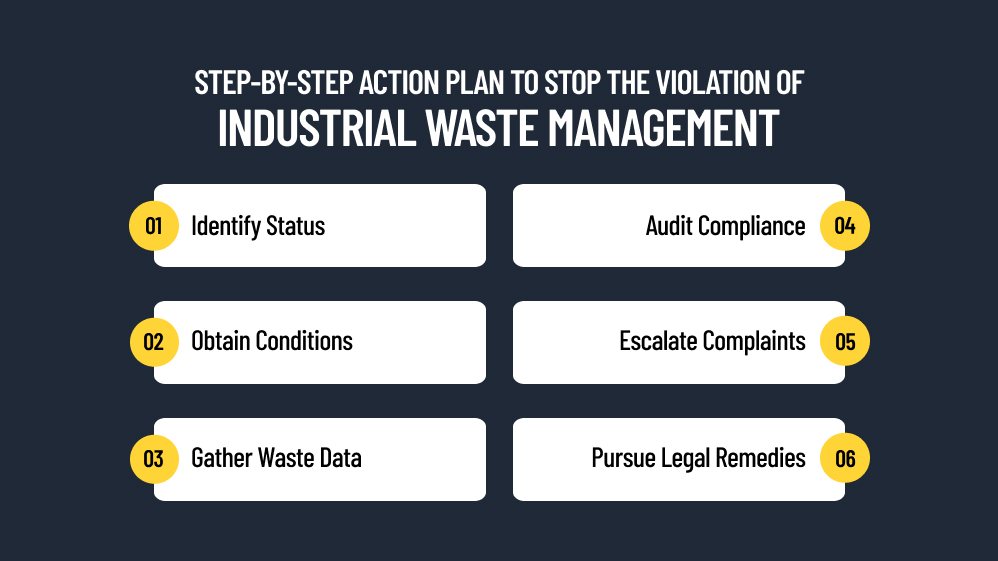
This is a records-first strategy.
Follow this step-by-step process and find and download the complaint template at the end of this article.
| Step | Action Item | Target Entity / Tool | Key Focus Areas | Timeline/ Constraints |
|---|---|---|---|---|
| 1 | Identify status | State Board or local body | Verify if the unit qualifies as a bulk generator based on 2026 thresholds. | Immediate initial check |
| 2 | Obtain conditions | State Board website, PARIVESH, or RTI | Request official consent and environmental clearance conditions. | Pre-investigation |
| 3 | Gather waste data | Target unit / Public records | Seek quantities, segregation practices, authorised recipients, and reduction measures. | Data collection phase |
| 4 | Audit compliance | Internal analysis | List every condition the unit appears to miss, backed by dates and evidence. | Gap analysis phase |
| 5 | Escalate complaints | State Board & CPCB | Send the gap list to the State Board; escalate to CPCB if unresolved. | Wait 30 days before CPCB escalation |
| 6 | Pursue legal remedies | Public hearings & National Green Tribunal (NGT) | Speak out at expansion hearings and file applications for persistent non-compliance. | Apply to NGT within six months |
You must maintain the records of all the requests in writing. Factual records always beat arguments.
What Is Strong Evidence?
- Dated photos and videos with a visible location marker.
- Vehicle numbers, loading times, and the name of the unit.
- Copies of complaints, acknowledgements and replies.
- RTI responses showing consent, authorisation or inspection reports.
Mistakes To Avoid While Filing Complaints Against Industrial Waste Management
You cannot ask for numeric reduction targets that were never set in the clearance conditions of a specific unit.
Furthermore, you cannot ask for waste data without naming the period, document, or stream.
Also, you cannot lodge a complaint against the factory in general without specifying the actual concern or fault.
Reduction is the least glamorous part of waste law and the most effective.
Every tonne not generated is a tonne nobody has to dump, burn, or argue about later. Push for it through paperwork first, and escalate when the paperwork shows gaps.
If the unit belongs to an industrial estate or cluster, also check whether it uses a common treatment facility.
Shared facilities have their own consent conditions, and a unit that sends waste there must still meet its own reduction and segregation duties.
Industrial Waste Management: Frequently Asked Questions (FAQs)
Here are the frequently asked questions and answers about industrial waste management.
1. Is Waste Reduction Mandatory Or Optional?
Waste reduction is mandatory, and the laws are strict, especially after the Solid Waste Management Rules, 2026 came into effect from 1st April.
However, the numeric targets mainly come through consent or clearance conditions.
2. Do The 2026 Rules Apply To Factories?
Yes, the 2026 rules apply to factories, industries, and industrial areas.
Also, any facility generating multiple types of solid waste or qualified as Bulk Waste Generators (BWGs) has to follow the rules.
Yes, where a unit qualifies as a bulk waste generator or uses solid fuel.
3. Where Do I Find Clearance Documents?
You will find the environmental clearance documents from the PARIVESH portal, the State Board, or RTI.
When filing the RTI online, you can address it to the Public Information Officer (PIO) of your local municipal corporation or State Pollution Control Board.
4. What Is RDF?
RDF means refuse-derived fuel.
RDF is made from non-recyclable waste, which solid-fuel industries must use in part.
5. Can Citizens Really Change Industrial Behaviour?
Of course citizens can really change industrial behavior.
You are filing documented complaints and participating in public hearing, you can raise a powerful voice against industrial waste mismanagement.
The Ganga Pollution Case (M.C. Mehta v. Union of India, 1987) and
The Doon Valley Mining Case (Rural Litigation and Entitlement Kendra v. State of UP, 1985) are some landmark examples of citizens raising their voices to change industrial behavior.
6. Can I Attend A Public Hearing?
Yes, you can attend a public hearing for industrial waste management or related environmental clearance projects.
You can attend the meeting as a local resident, an environmental group, or an individual with a plausible stake in the environmental impact of the project.
7. What If The Unit Calls Its Data Confidential?
If a unit calls its data confidential, ask which part it is and why it is protected.
Also, use your Right to Information to file an application seeking the information and data.
Compliance records are generally open to scrutiny.
Downloadable Complaint Letter Template
Fill in the bracketed fields, attach evidence, and submit with a stamped acknowledgement.
To: The Member Secretary, [State] Pollution Control Board, [Address]
Copy to: The Regional Officer, [Region]; Central Pollution Control Board, Delhi
Subject: Complaint against illegal industrial waste reduction by [Factory name], [Address]
Respected Sir/Madam,
I wish to report that [Factory name], located at [Address], is failing to follow the waste hierarchy and the reduction, reuse, and recycling conditions of its consent or clearance.
On [dates and times], I observed [describe what you saw]. Dated photographs, video, and a location pin are attached.
This conduct appears to violate the Solid Waste Management Rules, 2026, the Hazardous and Other Wastes (Management and Transboundary Movement) Rules, 2016, and the Environment (Protection) Act, 1986.
I request (1) an urgent inspection and, where relevant, sampling; (2) verification of the unit’s consent and authorisation; (3) action under the applicable laws; and (4) an acknowledgement and an action taken report.
Yours sincerely,
[Name] | [Address] | [Phone] | [Email] | [Date]
Enclosures: photographs, video, location pin, vehicle numbers, earlier correspondence.