





How To Play Trouble Game: Pop-O-Matic Rules, Setup, Version Differences, And Winning Tips
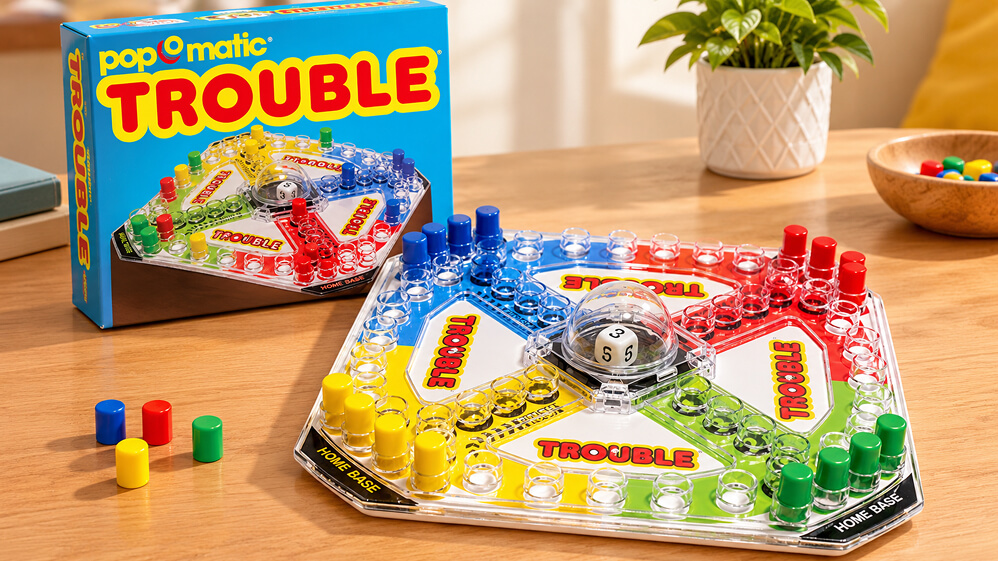
Trouble is a fun board game with two to four players.
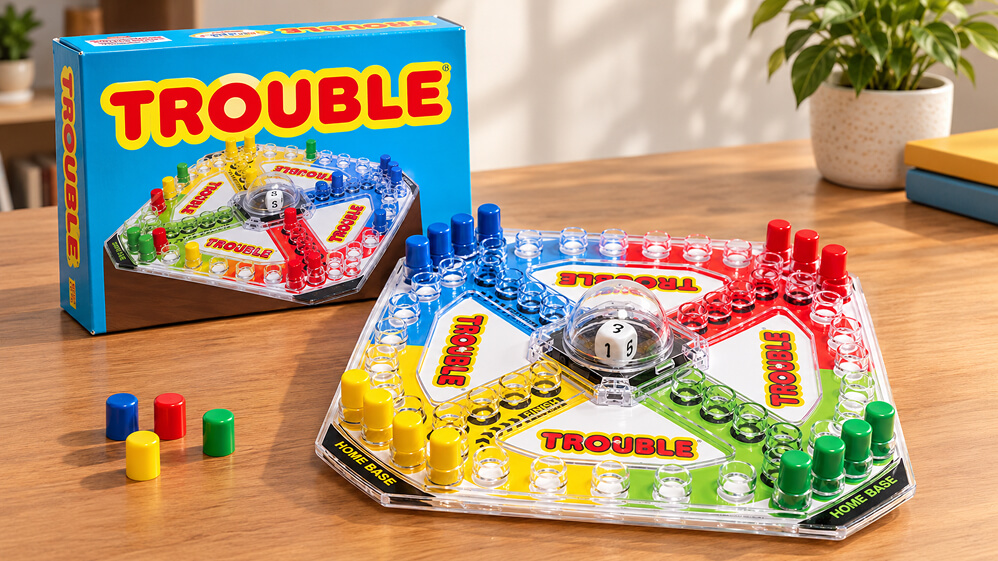
The board has a small dome-like section or plastic bubble in the center.
You have to pop it so that the die bounces and you get the numbers.
Here, like the game of Ludo, you play with tokens of four colors.
Also, a token gets out of its home and starts moving across the board once you pop a 6 in the central dome-like section.
Again, when you move the pegs/tokens clockwise, you bump rivals back home.
The first player to have all the pegs in the Finish Zone wins the game.
However, despite being an easy strategy game, Trouble often triggers nasty arguments.
So, in this article, I will discuss the rules according to the official instructions of Hasbro, the setup, the winning tips, and more.
Let’s play this classic family board game.
What Is The Trouble Game? Where Did It Come From?
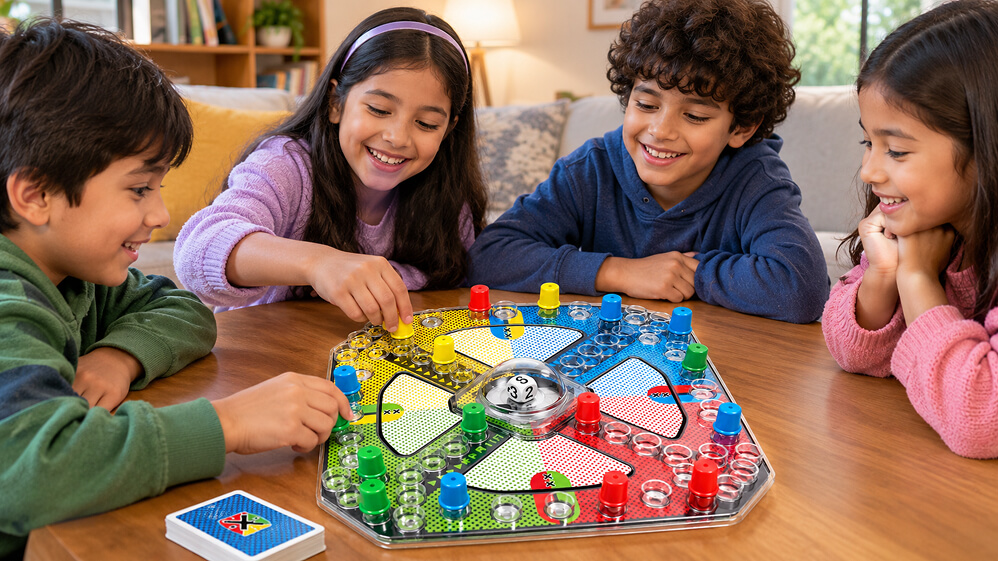
Trouble, as the name suggests, is about a lot of fights and noises.
The difficulty level is low in this game, and there is a bit of a luck factor.
Also, on average, completing a round of the Trouble board game takes 30 to 45 minutes.
The Kohner Brothers And The Pop-O-Matic Dome
The Kohner Brothers, Frank and Paul, developed the Trouble Game.
It was launched in America by Irwin Toy in 1965 and later by Milton Bradley.
Today, this game is owned by Hasbro.
Moreover, the central clear bubble or dome is where the game is made or ruined.
Also, it acts as an added safety feature.
It prevents the die from being lost. Also, it reduces the choking hazards.
Furthermore, while playing Ludo, we always used to fight over improper rolling. In the Trouble Game, you cannot touch or manipulate the die.
Trouble Game: A Board Game Similar To Pachisi And Ludo
The Trouble Game shows similarities with the Indian Game of Pachisi or Pasha.
This connection again takes us to the epic Mahabharata.
The entire war of Kurukshetra started when the Pandavas lost in the game of Pasha to the Kauravas.
Furthermore, we all have played the game of Ludo, which has a British origin.
Also, the same game has many names across different countries.
In the UK, it is known as Frustration, and in Finland, they call it Kimble.
The Trouble Game At A Glance: Official Specs
| Detail | What the Sources Say |
|---|---|
| Players | 2 to 4 |
| Official age | 5 and up |
| Playtime | 30 to 45 Minutes |
| In the box | Gameboard, Pop-O-Matic Unit, 16 Pegs, Instructions |
How To Set Up And Start The Game?
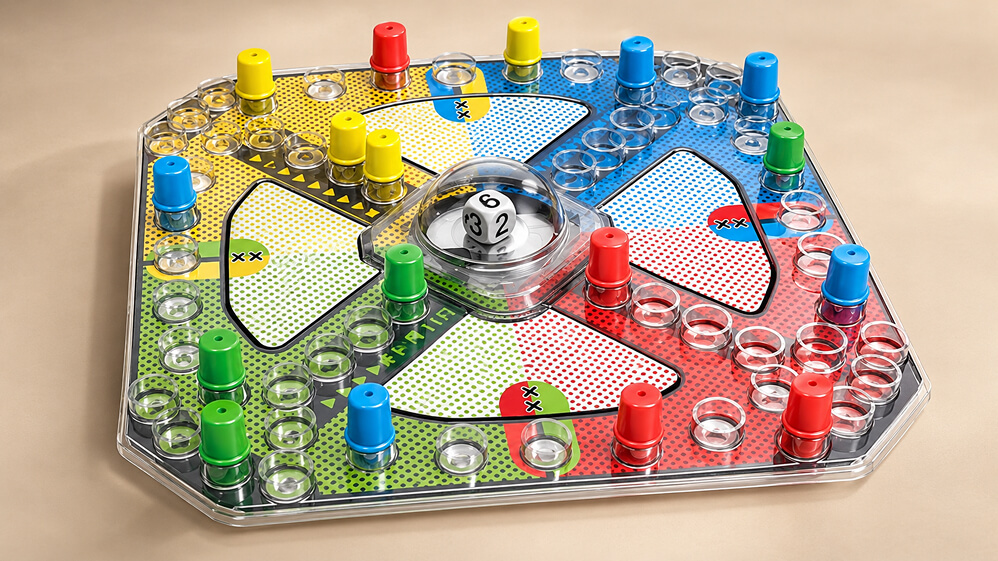
The Trouble Game is easy to set up.
Place the game board and the plastic unit with the Pop-O-Matic die roller on a sturdy surface.
You have to place the 16 pegs, including 4 pegs of each color, on the board.
Each player will pick the peg of a specific color.
If there are two players, each player will pick the pegs of two different colors.
Now, there can be a little friction over who starts the game.
In the new version, the youngest player gets to start the game.
However, I prefer the rule of the older version regarding how the game should be started.
Ask every player to pop the bubble.
Once the die bounces, the player who gets the highest number starts the game.
The game further moves clockwise.
How To Take A Turn In The Trouble Game?
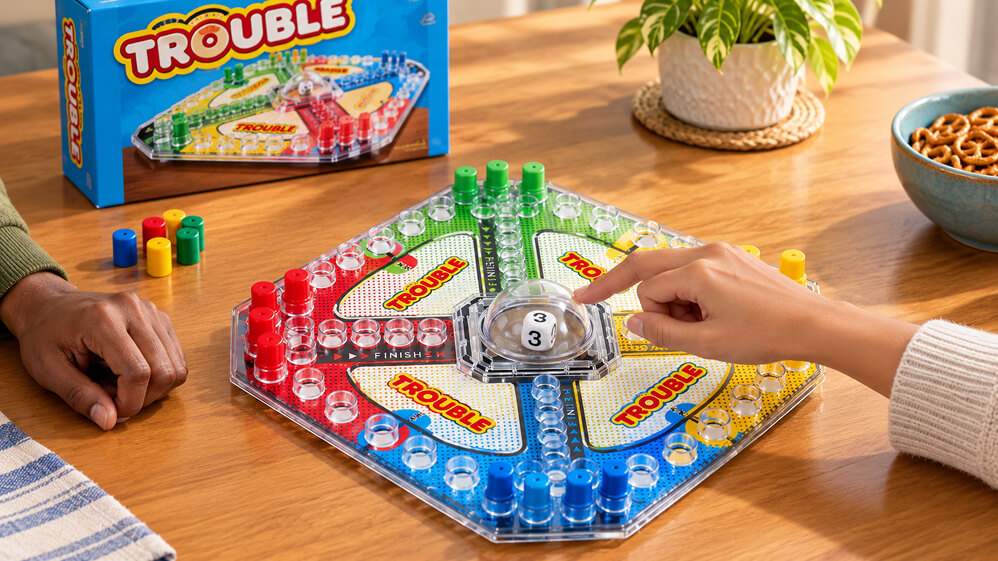
Taking a turn in the Trouble Game begins in the same way every time.
You have to press the bubble in the middle of the board.
The die is bounced, and you get the number.
Then, you move the pegs based on that number.
Rolling A 1
There is a difference in what to do when you roll 1.
When you roll 1, according to the older version, the peg moves one space forward.
However, in the newer version, if you roll 1, you will do nothing, and every other player will move a peg from Home to their Start space.
Anyone who already has their own peg on Start gets no peg.
If an opponent’s peg is sitting on that Start space, it goes back Home.
Rolling 2 Through 5
Move one peg forward that many spaces, clockwise, counting both empty and occupied spaces.
If none of your pegs are on the board, you forfeit the turn.
Rolling A 6
You have two choices when you roll a 6.
You can either bring a peg out of home onto Start.
Otherwise, you can move a peg, which is already on the board, six spaces forward.
Also, remember that once you roll a 6, you will get the chance to pop the bubble again.
If you get a 6 now, you will pop the bubble again.
Unlike Ludo, in Trouble, there is no rule of cancelling a move if you get a 6 three times consecutively.
Bumping, Blocking And Special Spaces
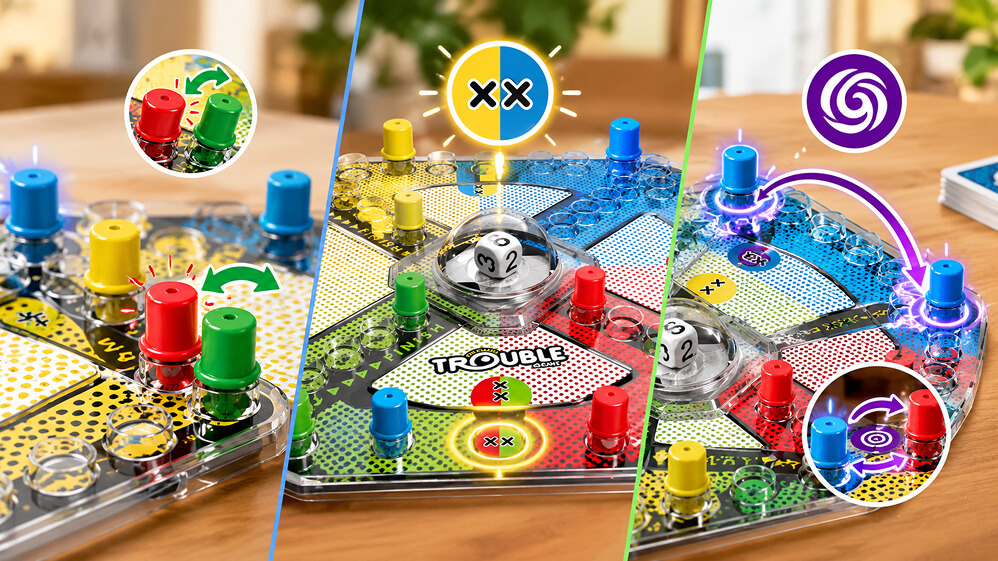
Contact is the whole point of Trouble, and it is where leads evaporate.
Landing On Another Peg
You cannot land a peg of yours on a space that is occupied by your other peg.
You have to either move a different peg or forfeit the turn.
However, if a peg of your opponent is occupying that space, you can return it to its Home Space.
The Double Trouble Or Power Up Space
In newer versions, the boards have Double Trouble Spaces.
These are the spaces where two colors meet.
If you are landing on one such a place, you will take another turn.
However, if you have reached the Double Trouble Space by rolling a six, you will only get one extra turn and not two separate turns.
Warp Spaces
Hasbro officially mentions that the Double Trouble or Warp spaces add extra powers.
However, the current retail copy refers to optional Power Up spaces for a more challenging game.
Suppose your peg lands on a Warp space.
It immediately teleports to the base of the connected Warp path on the opposite side of the board.
If that space is occupied by your opponent’s peg, you can send that back home.
Reaching The Finish And Winning
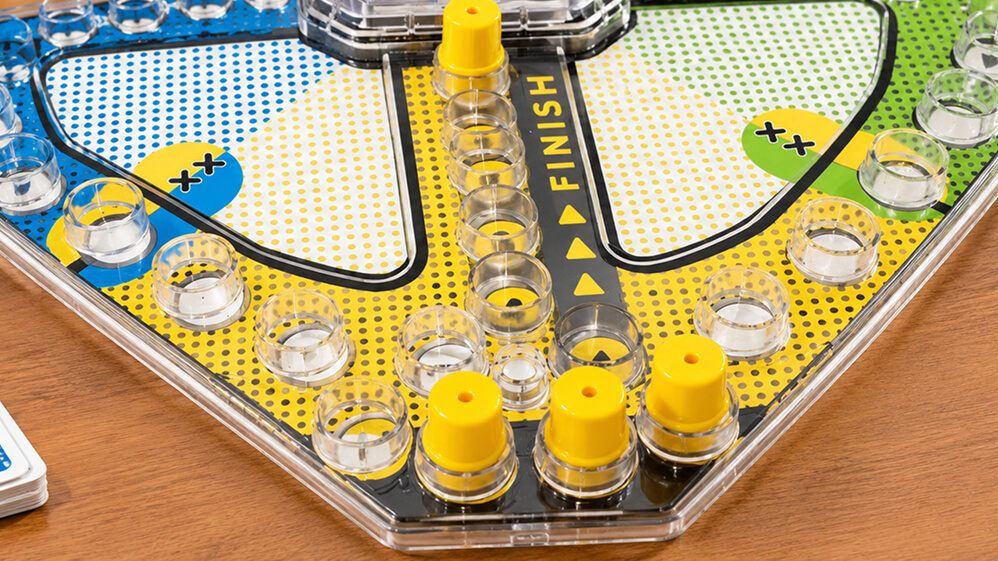
After moving a full lap, the peg turns off the main track and heads for safety.
If a peg has reached the Finish Zone, it cannot be bumped for the rest of the game.
Exact Count Or Not
Newer rules drop the exact count: reach the Finish Zone and the peg goes to the space closest to the die popper.
Older rules demand an exact roll.
The peg stays where it lands and can move deeper on later rolls, never backward, and never onto a space holding your own peg.
Winning The Game
The first player to get all four pegs into their Finish zone wins.
Old Rules Vs. New Rules At A Glance
| Situation | Older versions | Newer versions |
|---|---|---|
| Rolling a 1 | Move one peg one space | Everyone else may bring out a peg |
| First player | Highest pop starts. | Youngest player starts. |
| Finish zone | Exact count needed. | Exact count not needed. |
| Extra-turn spaces | Not described. | Double Trouble gives another turn. |
| Add-ons | None described. | Warp (2013 to 2016) and Power Up options. |
Strategy: How Much Can You Actually Control?
Trouble Game is not a strategy game, and it does not require skills such as Telestrations.
Honestly, not much, and anyone selling Trouble as a strategy game is overselling it. A few decisions still matter.
The Math Behind The Pop
I have my own calculation behind the pop.
A 6 comes up one time in 6.
So, the chances of getting a six are around 16.7%, and the chance of missing a six is 58%.
Thus, a player depending on sixes alone is more likely than not to sit at Home for a full round.
That wait is the emotional engine of the game.
Practical Tips
- Clear your Start space.
You cannot bring out a new peg while your own sits on Start, so move it along.
- Beware of parking on a rival’s Start.
A peg there is sent Home the moment that player brings one out.
- Protect progress.
Pegs in the Finish zone are safe.
So, a peg near the turn is worth more than a peg far ahead of the pack.
Cost And Where To Buy
Most editions of the Trouble Game can be found for roughly $10 to $15.
Price Snapshot
| Retailer | Listed price |
|---|---|
| H-E-B | $9.84 |
| King Soopers | $9.99 |
| Contrarian Gaming | $14.99 |
| Canadian Tire | C$23.99 |
Prices change often, so confirm before buying.
Safety And Real Risks
The pegs are small, and that is why these are not free of choking hazards.
Also, the game is not suitable for children under 3 years.
However, Trouble endures because it is fast to teach, loud to play, and honest about being a game of chance.
A ten-dollar race with a popping bubble still earns its shelf space.
Settle the rules version first, count your pegs, and accept that the die, not you, is the real player.