

What Happens If You Don’t Pay Your Water Bill? Does The Board Cut Your Supply?
Quick Answer:
If you don’t pay your water bill, the board does not cut your connection immediately.
However, missing a water bill payment first adds a late surcharge and carries the dues into your next bill.
In fact, this is one of the reasons why your water bill can go up suddenly.
Also, if you are missing bill payments continuously, you will get notices, which can finally lead to disconnection.
Restoring the supply is expensive, as you will have to pay arrears and reconnection charges.
Many of us are far less particular about paying our water bills on time than we are with our electricity bills.
Apparently, missing the water bill for a month is not a big issue. However, it has serious consequences when you forget to pay the bills continuously.
The bill will go up with each due date, and you will get notices from the board, which will cut your connection after the stipulated timeline as set in the rules.
So, in this guide, I will discuss the practical problems of not paying your electricity bill on time and what you can do to avoid them.
What Happens If You Don’t Pay Your Water Bill On Time: Stage By Stage
| Stage | Trigger | What Happens? |
|---|---|---|
| Surcharge | Due Date Missed | Late surcharge added at the current rate when the bill fell due. |
| Arrears Build | Next Billing Cycle | Old dues carry forward, and a surcharge accrues on them. |
| Notice | Default for About Two to Three Months | The board issues a notice for disconnection. |
| Disconnection | • Missed Billing Cycles of 2 to 3 (60 to 90 Days). • Then a Formal Notice Period of 10 to 15 Days. • Rules Vary by City and State. | • Supply Cut • Reconnection After Arrears and Charges |
| Recovery or Seizure | Large Unpaid Sums | • Recovery Action. • Property Sealing Warnings for Commercial Users. |
What Happens The Day After The Due Date?
There is a high chance that you will not notice anything after missing the water bill for the first time.
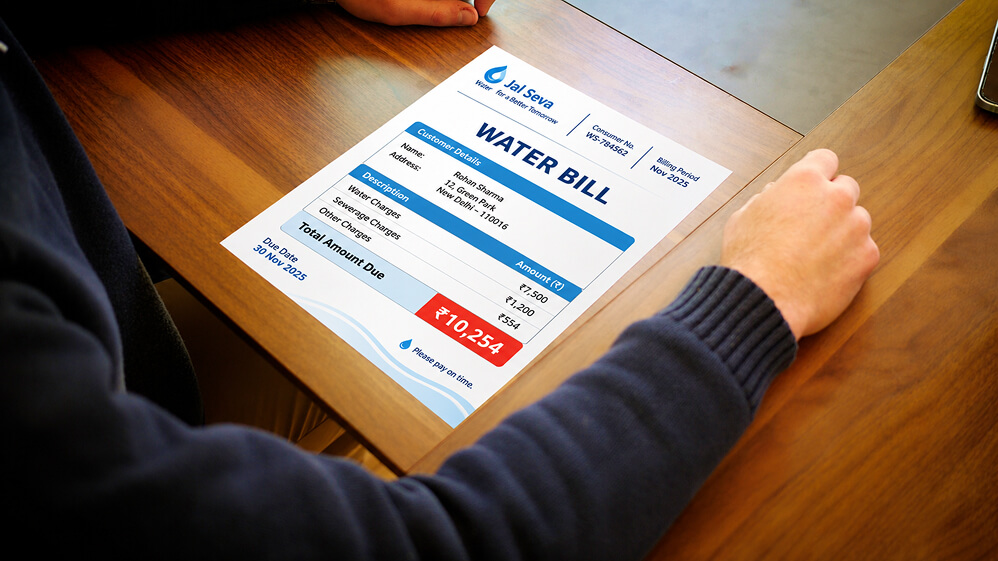
However, you will notice the impact when the next bill arrives, as you will have to pay a surcharge at the rate in force when the bill was due, along with the water charges.
If you do not receive a bill for a month, you must reach out to your local water supply board, as missing the due date due to not receiving the bill on time does not offer you any relief.
You can also download the bill from the portal if you have not received the physical copy of the bill.
The Delhi Jal Board shows how large the payment surcharges can grow.
The government waived what it described as nearly ₹11,000 crore of accumulated late payment surcharge.
Also, the Delhi Jal Board (DJB) has extended its 100% Late Payment Surcharge (LPSC) waiver scheme until March 31, 2027.
They have extended the date from 15th August 2026, and the 100% waiver is on the Late Payment Surcharge (LPSC) when you pay the outstanding principal amount (and current bill dues, if applicable).
When Will The Water Board Cut Your Supply For Non-Payment Of Bills?
There is no umbrella rule in India for states regarding the duration of disconnection for the non-payment of water bills.
Water supply is a state and municipal subject. So, every board sets its own rules.
What Do Published Rules Actually Say?
Goa’s PWD has stated that connections with payments pending beyond two months are liable for disconnection.
Also, it has said that defaulters may be disconnected on the spot, with notice and final bill following.
Furthermore, according to many state-specific Water Supply and Sewerage Rules, if a consumer defaults for three consecutive months, there will be disconnection.
Kerala, Karnataka, Jharkhand, and Arunachal Pradesh are some of these states that follow this rule.
Also, the formal notice period is 10 to 15 days across states.
Delhi Water & Sewer (Tariff and Metering) Regulations, 2012, in its Regulations 40 and 41, state the details of water disconnection and restoration.
Regulation 40 (a) (i) says,
“The Executive Engineer or his authorized subordinate shall have the power to disconnect the water supply in any of the following circumstances after giving three clear days’ notice in writing to the owner/occupier or consumer:
i) Where there is default in the payment of water bills, meter rents, or meter repairs within two billing cycles.”
However, the norms of your local water supply board can be different. So, check with them.
What Does Getting Reconnected Involve?
Usually, one has to clear all the arrears and pay reconnection charges to restore the water connection.
However, there can be some additional conditions set by your local water board.
For example, according to the Goa board, reconnection can be claimed only within one year of disconnection. After one year, you will have to apply for a new connection.
So, there will be fresh fees and paperwork. So, a disconnected tap is not just an inconvenience. It can also be the wait and hassle for a whole new connection.
Again, Regulation 41 of the Delhi Water & Sewer (Tariff and Marketing) says,
“In the eventuality of a disconnection by the Board, the consumer may apply
for restoration of water supply after rectification of the fault and on payment
of opening fee and disconnection fee and Road Restoration Charges.
The cost of restoration of water supply shall be borne by the consumer.”
Can The Board Take Legal Action Or Seal Property?
Yes, in certain jurisdictions and under specific statutory powers, boards can take legal action or seal property.
For example, the water minister of Delhi, Parvesh Sahib Singh, issued a statement in August 2026 that the board had sent notice to the water bill defaulters of ₹25 lakhs or more.
If they did not clear their dues within 15th August 2026, the board will seal or attach their properties under legal provisions.
However, the measure was for the commercial water bill defaulters, as he said to the press,
“So far, we have identified 1,025 commercial properties with outstanding water bills of `25 lakh or more accumulated over the years.
If they fail to pay within the given deadline, appropriate action will be taken in accordance with the rules.”
There is also a practical aspect for you as the property owner.
When you sell or transfer a property, buyers and their lawyers commonly ask for proof that utility dues are cleared.
An old unpaid water bill can stall a deal at the worst moment.
Courts have read access to safe drinking water into the right to life under Article 21.
That does not mean a board must supply water forever to a non-paying connection. After due notice, disconnection remains an established power.
However, if you believe a disconnection was wrongful or the bill was wrong, you can appeal to the board and approach the grievance commission or a court.
What If The Board Cuts Supply Wrongly?
Wrongful disconnections by the board can happen, and cases are common when a payment was made but not credited.
Keep your receipt or UPI screenshot, file a complaint with the docket number the same day, and ask for restoration without reconnection charges because the default was not yours.
What Should You Do If You Cannot Pay Your Water Bill Right Now?
| Steps | What to Do | Why It Helps |
|---|---|---|
| 1 | Download the full bill breakdown from the portal. | Separates principal, surcharge, and arrears. |
| 2 | Pay the principal first if you can only pay part. | Surcharge schemes have rewarded principal payment. |
| 3 | Write to the zonal revenue office asking for instalments. | Creates a record of good faith. |
| 4 | Dispute any wrong portion in writing and keep the docket number. | Shows the amount is contested. |
| 5 | Ask whether any waiver or rebate scheme applies. | Past schemes cut the surcharge sharply. |
| 6 | Keep every receipt and screenshot. | Evidence if supply is wrongly cut. |
One more habit you can develop to avoid missing your water bill.
Set a calendar reminder three days before the due date, or enable your board’s online payment alerts.
Most unpaid bills are not acts of defiance. They are acts of forgetting, and forgetting is cheaper to fix than defaulting.
Frequently Asked Questions On The Impact Of Not Paying Your Water Bill (FAQs)
Here are the frequently asked questions and answers about what happens if you don’t pay your water bill.
Who Is Responsible For An Unpaid Water Bill If The Property Is Rented Out?
The water connection is usually registered in the property owner’s name. So, the board holds the owner responsible for any dues, even if the tenant was using the water.
The tenant’s liability depends on your rental agreement.
Many owners add a clause making the tenant pay utility bills. In such cases, before vacating, tenants should clear all dues and collect a receipt to avoid disputes later.
Can An Unpaid Water Bill Affect My Credit Score?
No, an unpaid water bill does not usually affect your credit score.
Water boards and municipal bodies do not usually report unpaid bills to credit bureaus such as CIBIL.
So, a missed payment does not directly lower your credit score.
However, the consequences are still real. Surcharges build up, the supply can be cut, and large dues can lead to recovery action.
Some boards may also recover unpaid amounts as arrears of property tax or land revenue.
Do I Still Have To Pay The Water Bill If My House Is Vacant?
Yes, you will have to pay the water bill even if your house is vacant and it has a working connection.
The board usually charges a minimum or fixed amount each billing cycle, even when no water is used.
If the house will stay empty for a long time, apply in writing to the board for a temporary disconnection or closure.
Do not simply stop paying, as the dues and surcharges will keep growing.
What Should I Do If My Water Bill Is Unusually High?
First, compare the bill with your previous readings and check the meter yourself for leaks or a running tap.
Then raise a complaint with the zonal office and request a meter inspection or re-reading.
A faulty meter or an estimated reading is often the cause. So, ask for a review of the disputed amount and pay any undisputed portion so that late surcharges do not pile up.
How Can I Pay My Water Bill Online?
Most water boards now have an official website or app where you can pay using your consumer or connection number.
You can usually pay through UPI, net banking, debit or credit cards.
Many states also accept payments through bill-payment apps and their own payment portals.
Always use the board’s official link, and save the payment receipt or transaction reference number as proof of payment.
How Do I Transfer The Water Connection To My Name After Buying A Property?
Apply to your local water board for a change of name or ownership.
You will usually need the sale deed, an ID proof, a recent tax receipt, and a no-dues certificate from the previous owner.
The board may also charge a small transfer fee. Clear any pending bills before applying, as many boards will not process the transfer while old dues remain.
How Can I Confirm That My Water Bill Payment Has Been Credited?
Check your account on the board’s portal or app, where the payment history usually shows the amount paid and the date it was credited.
You can also look for a confirmation SMS or email, or collect a receipt from the zonal office.
Online payments sometimes take a few days to reflect. If your money has been debited but not credited, contact the board with your transaction ID.