




LPG Vs CNG: Which Fuel Is Cheaper And Safer In 2027?
Quick Answer
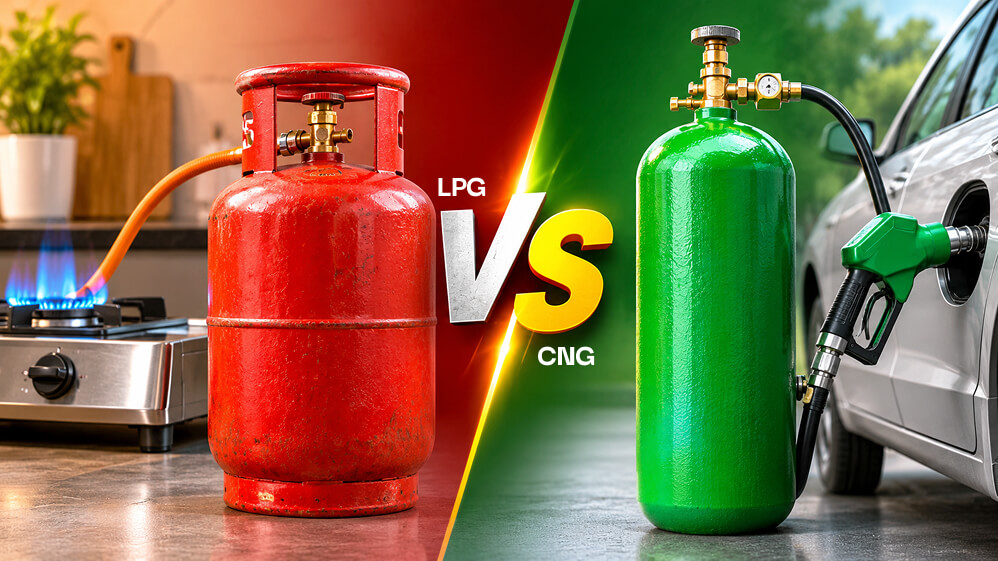
LPG means Liquefied Petroleum Gas, and it is a mix of propane and butane.
It is heavier than air, and it comes in cylinders for cooking.
CNG, on the other hand, means compressed natural gas.
It mostly has methane.
It is lighter than air, and companies sell it by the kilogram for vehicles.
There is also a noticeable difference in the pricing of the two types of gas.
In Delhi, CNG costs ₹86.98 per kg from 29 August 2026, and a 14.2 kg cooking cylinder costs ₹942.
A Quick Reference: LPG Vs CNG AT A Glance
| Parameter | LPG | CNG |
|---|---|---|
| Main Gas | Propane and Butane | Methane |
| Compared with Air | • Heavier • Sinks and Pools | • Lighter • Rises and Disperses. |
| Storage | Liquefied at moderate pressure in cylinders. | Compressed at very high pressure. |
| Typical Use | • Home Cooking • Auto LPG at Authorized Outlets | Vehicles; its piped form, PNG, serves homes. |
| Delhi Price | • ₹942 per 14.2 kg cylinder • So, it is about ₹66 per kg. | ₹86.98 per kg (29 August 2026) |
| Governing Law | • Gas Cylinder Rules, 2016. • LPG supply order. | • PNGRB Act, 2006 • Motor Vehicles Rules |
What Is The Difference Between LPG And CNG?
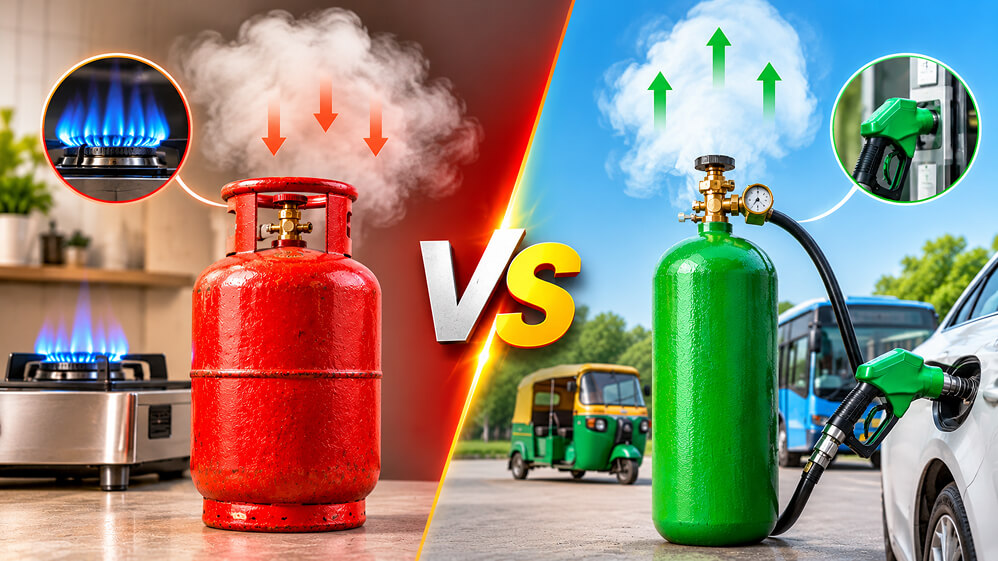
LPG and CNG are different in behavior and have different legal uses.
Composition And Behavior
LPG is a liquefied mix of propane and butane.
So, when released, it turns into a heavy gas.
CNG, on the other hand, is natural gas compressed to very high pressure. It is usually methane and rises quickly in open air.
Where Is Each Type Of Gas Used?
You buy LPG for cooking in households. LPG fills household cylinders, and Auto LPG is a separate product available at authorised outlets.
Similarly, CNG fuels cars, autos, and buses.
The pipeline form, PNG, is closely related to CNG because of the use of natural gas and how it is supplied through pipes.
However, CNG is compressed at a high pressure, and PNG is compressed at low pressure.
LPG Vs CNG: Which Fuel Costs Less?
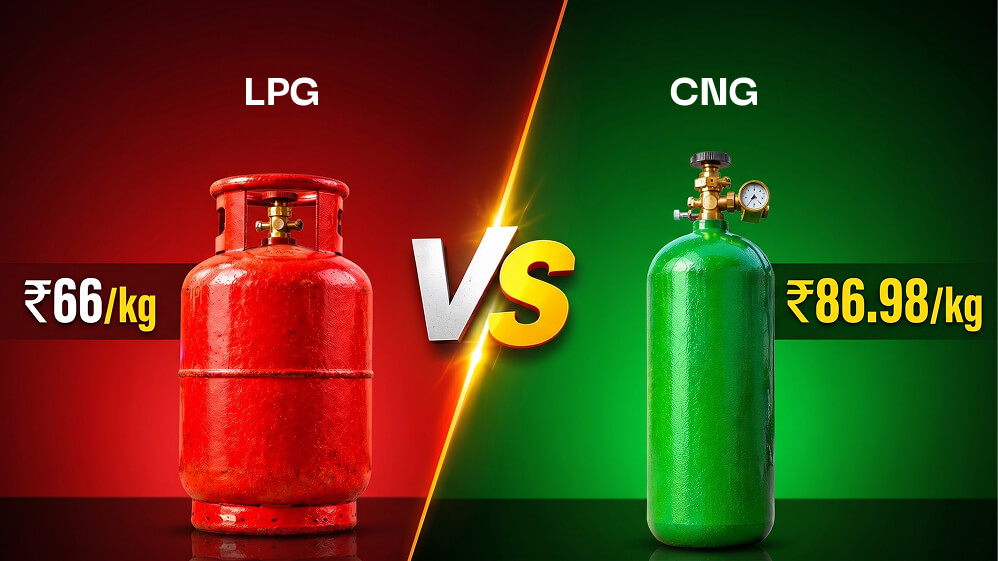
If we compare the price of LPG and CNG per kg, this is what we find.
Delhi’s domestic cylinder works out near ₹66 per kg against ₹86.98 per kg for CNG.
However, the ministry says the market-determined June 2026 price would have been ₹1,695 per cylinder, about ₹119 per kg, and oil companies absorbed the gap.
Also, under the PMUY scheme, many households get an LPG subsidy of ₹300 for a 14.2 kg cylinder.
If you are eligible under this scheme, you will have to pay the market price when you book the LPG, and you will receive the subsidy amount directly into your registered bank account.
So, the domestic LPG cost seems lower because of the support that oil companies or the government offers.
Prices Vary By City And State For CNG
CNG prices vary by city due to local taxes.
For example, after the August hike, the CNG price is ₹95.59 per kg in Noida and Ghaziabad and ₹92.01 per kg in Gurugram.
Delhi’s CNG has risen about ₹10 per kg in 2026 on higher imported LNG costs.
Again, the charges differ by state. After the hike on 16th August 2026, the CNG price in Kolkata, as confirmed by the Bengal Gas Company Limited, is 103 per kg.
Also, prices are reviewed daily. So, confirm the charges on the day on which you are buying CNG for your vehicle.
The Central Vs State War In LPG Pricing
The charges of domestic and commercial LPG cylinders also vary from one state to another.
For example, in Delhi, the price is ₹942, but in Kolkata, West Bengal, it is 969 for a 14.2 kg cylinder.
However, here, I want to discuss a misconception about the GST distribution on each LPG cylinder between the center and the state.
The misconception was, “The Central govt levies only 5% on an LPG cylinder whereas the state tax is 55%.”
An India Today report, however, has stated the fact.
“Taxing of LPG cylinders falls under the GST regime.
For a domestic LPG cylinder, 5% GST is charged, which is equally divided between the Centre and the state.
So, there is no disparity in the taxes charged on an LPG cylinder.”
Which One Is Safer?
LPG and CNG are used for different purposes, even though PNG, the pipeline version of CNG, is common in many Indian households today.
Both are safe when you use certified equipment and follow safety norms.
Leak Behaviour
CNG disperses upward in open air, which lowers the chance of gas pooling.
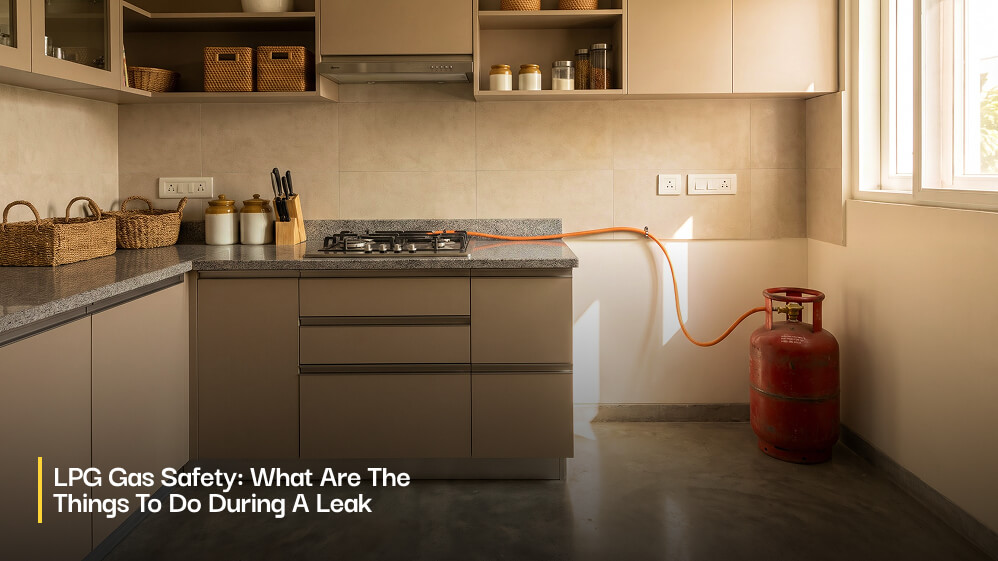
LPG sinks into drains and low corners, where a spark can ignite it.
In closed rooms or garages, both are hazardous, so ventilation matters for each.
Equipment And Legality
A CNG kit retrofitted to a petrol car needs an approved fitter and an RTO endorsement on the registration certificate.
CNG cylinders are tested periodically.
For LPG, use ISI-marked regulators and hoses and never refill cylinders informally.
How Should You Choose Between LPG And CNG?
You should choose between LPG and CNG based on the use. Then compare running cost and certification.
| Step | What to Do | Tip |
|---|---|---|
| 1 | Define the useVehicle or Kitchen | Do not mix the two. |
| 2 | Check SupplyCNG stations or PNG pipeline near you. | Ask your housing society. |
| 3 | Compare running costs at local prices. | Use per kg, not per cylinder. |
| 4 | Verify CertificationISI parts, approved kit, RTO entry | Keep receipts. |
| 5 | Plan for inspections and refills. | Follow the test due dates. |
Note:
The prices and other rules mentioned in this article are based on the data from Indraprastha Gas, the oil company, and ministry statements as verified in November 2026.
However, the prices keep changing. So, check the current pricing on the official website or app of your distributor.
Also, the per-kg pricing comparison here does not assess the efficiency and appliance differences.
So, refer to the pricing comparison as a guide and not a quote for decision-making.
LPG Vs CNG: Frequently Asked Questions (FAQs)
Here are the frequently asked questions and answers about LPG vs CNG comparison.
Can I Use Domestic LPG In My Car?
No, you cannot use domestic LPG in a car. Domestic cylinders are only for household cooking.
Using them in vehicles is illegal and dangerous because they lack the fittings and testing a vehicle fuel system needs.
If you want a gaseous fuel for your car, choose a certified CNG or Auto LPG kit. Certified conversion is the only legal route.
Is PNG The Same As CNG?
No, PNG and CNG are not exactly the same.
The similarity is that both are natural gas, mostly Methane. However, the delivery method is different.
CNG is compressed into vehicle cylinders at stations, while PNG flows through pipelines at low pressure into kitchens and is billed by use.
In 2026, households with PNG access have to surrender LPG.
So, check which one your society uses.
LPG Vs. CNG: Which Fuel Is Cleaner?
CNG, a highly compressed natural gas, is cleaner than petrol or diesel and produces fewer particulates.
LPG is also cleaner than wood, coal, or kerosene for cooking.
However, the real-world benefits of CNG depend on the engine condition of the vehicle.
Similarly, the ventilation of the kitchen is a crucial factor for LPG.
Both still release carbon dioxide.
So neither is zero-emission, but each reduces smoke in daily use.
Does CNG Reduce Engine Performance?
Yes, retrofitted petrol engines can lose some power on CNG and need regular servicing of the kit.
However, factory-fitted CNG vehicles work fine with the fuel. The boot space may shrink, though, because of the cylinder.
Many drivers accept this trade-off for lower running costs, though the 2026 price rises narrowed that gap.
Also, ask your CNG fitter about tuning and warranty to ensure smooth running of your vehicle.
Why Do CNG Prices Differ Between Cities?
CNG prices differ between cities because city gas companies set prices based on gas procurement costs, local taxes such as VAT, and distribution charges.
For example, Delhi’s rate was ₹86.98 per kg, and it was ₹95.59 in Noida and Ghaziabad.
Prices also move with imported LNG costs, which rose after West Asia disruptions in 2026.
Moreover, local tax changes can raise or lower rates overnight.
Which Is Better For A New Kitchen?
If PNG is available at your address, it is the practical choice and increasingly the mandated one.
However, households with PNG access must surrender their LPG connection within 30 days.
Where it is unavailable, use a certified LPG cylinder from an authorised distributor.
Ask your housing society whether it has a pipeline, and also verify connection timelines with the city gas company.
Is CNG Safer Than LPG In An Accident?
The use of CNG and LPG is safe but not risk-free, especially if you are using outdated/non-compliant equipment or not following the safety norms.
Also, the severity or the aftermath depends on the situation.
CNG disperses upward, but its cylinders hold very high pressure and need periodic testing.
LPG pools at ground level. So, leaks near ignition sources are serious.
Certified equipment, approved fitment, and regular inspection matter more than the fuel itself.
Also, don’t store LPG or CNG in closed spaces, as ventilation is crucial for safety.