




How Is Electricity Bill Calculated In India? Know The Step-By-Step Process In 2027
Quick Answer:
An electricity bill calculates energy charges (Units Consumed x Slab Rates).
An easy formula for calculating the electricity bill is:
{(Units Consumed x Slab Rates) + Fixed or Demand Charges Based on the Sanctioned Load, Fuel and Power Purchase Adjustment, Electricity Duty, and Other Levies. }
Minus (-)
(Subsidy or Rebate)
Remember that one unit is equal to one kilowatt-hour.
Who Calculates The Electricity Bill?
The electricity bill you pay is charged by your specific distributor company and approved by the State Electricity Regulatory Commissions (SERCs).
For example, the bills of Maharashtra State Electricity Distribution Company Limited (MSEDCL) point readers to the tariff order on its consumer portal.
Furthermore, the Electricity (Rights of Consumers) Rules, 2020 focus on transparency in the applicable tariff and bills.
Why Are The Electricity Bills For Homes And Shops Calculated Differently?
The electricity bills for homes and shops are different because there are four categories of consumers.
- Domestic
- Commercial
- Industrial
- Agricultural.
Your bill will state the category.
Also, if you receive a bill with an unexpectedly higher rate, you must check the category.
Why Does The Electricity Bill Change When The Tariff Changes?
Yes, the electricity bill will change if the tariff changes.
For example, you are awaiting the electricity report for the month of October.
Now, a new tariff order comes into effect 15th October.
So, your electricity bill will be a combination of old and new rates.
However, if the calculation and the arithmetic look odd to you, you can ask the distribution company for clarification.
Also, if you are facing issues with electricity bill payment or you want to reduce your electricity bill, you must dial the helpline number of your distribution company mentioned in the electricity bill.
What Are The Components Of An Electricity Bill In India?
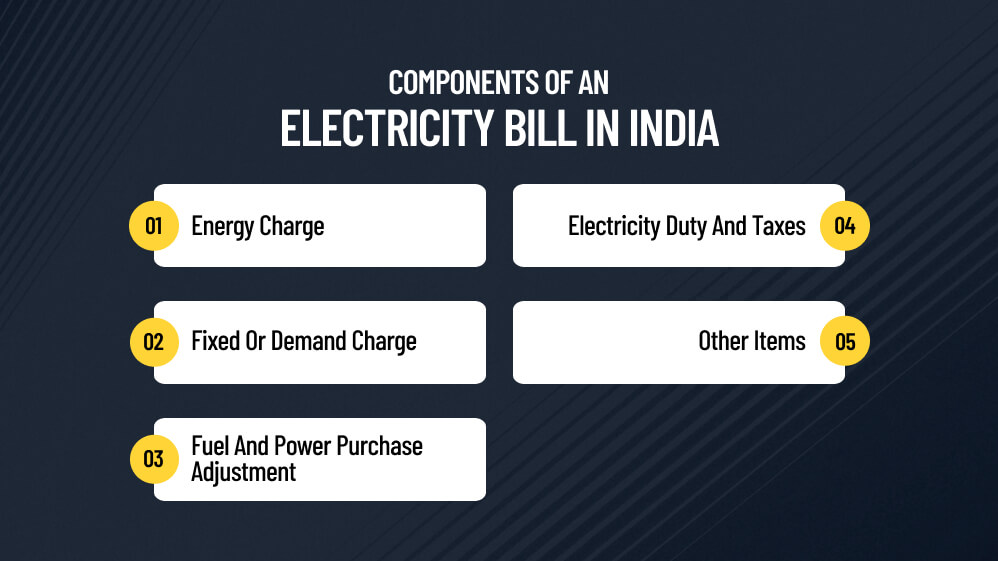
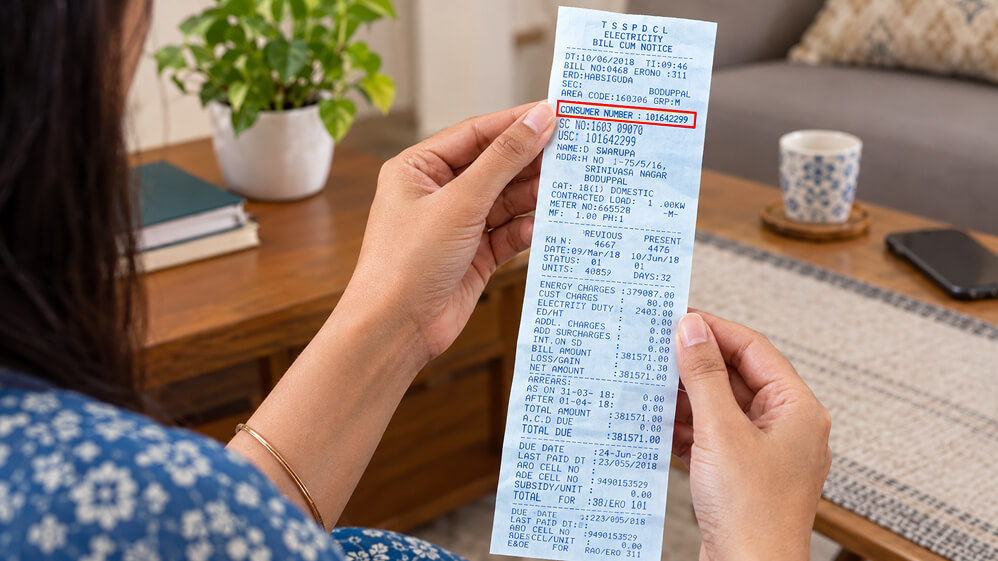
Most electricity bills in India have the same components.
However, the names of the components and rates will vary from one state to another.
| Components | What It Means |
|---|---|
| Energy Charge | Units consumed multiplied by the rate for each slab. |
| Fixed or Demand Charge | A monthly amount linked to sanctioned load. |
| Fuel and power purchase adjustment | It is a surcharge or credit for changes in power cost. |
| Electricity duty and taxes | These are state levies on the bill. |
| Other items | Meter rent, arrears, rebates, and subsidies. |
So, once you take a printout or download your electricity bill, you can do some simple math and check the accuracy of your electricity bill.
The Electricity Bill Calculation Formula
Once again, the formula to calculate your electricity bill is:
{(Units Consumed x Slab Rates) + Fixed or Demand Charges Based on the Sanctioned Load, Fuel and Power Purchase Adjustment, Electricity Duty and Other Levies} – Subsidy or Rebate
How Does The Fuel Surcharge Work?
SERCs have to decide a formula to pass fuel and power purchase cost changes to consumers automatically on a monthly basis.
This is according to Rule 14 of the Electricity (Amendment) Rules, 2022, notified on 29 December 2022.
Again, according to the same rule, the distribution companies (DISCOMs) can automatically recover variations in fuel prices and power purchase costs from consumers on a monthly basis.
The DISCOMS do not need to go through a lengthy regulatory approval process every time.
The Fuel and Power Purchase Adjustment Surcharge (FPPAS) Structure states the following.
FPPAS Recovery Thresholds
| Surcharge Level | Automatically Recoverable Amount | Deferred Amount (Subject to Commission Approval) |
|---|---|---|
| FPPAS ≤ 5% | 100% of the computed surcharge | 0% (None) |
| FPPAS > 5% | 5% + 90% of the remaining balance | 10% of the remaining balance (Recovered during the annual true-up) |
Moreover, any annual true-up of the FPPAS by the State Commission must be completed by June 30 of the following financial year.
How Does Slab Pricing Work In A Real Bill?
Here is an illustrative example of how slab pricing works in a real bill.
Please note that the rates here are illustrative and are not according to any state’s tariff.
Suppose the first 100 units cost ₹4.
The next100 units cost ₹6.
Furthermore, the units consumed above 200 units cost ₹8.
In this scenario, a household consuming 250 units of electricity will pay the following amount in energy charges.
(100 x ₹4) + (100 x ₹6) + (50 x ₹8) = ₹400 + ₹600 + ₹400 = ₹1400.
Now, with this, the fixed charge of ₹100 (2 kW at ₹50 per kW) and a fuel adjustment of ₹0.20 per unit (₹50) will be added.
So, the subtotal will be ₹1,550.
Furthermore, a 5% duty will be applied to the subtotal, which is ₹77.50.
So, the bill you need to pay is ₹1,627.50.
Do All States Use The Same Slab Method For Electricity Bills?
No, all states do not use the same slab method for electricity bills.
The process of increasing slab rates based on different portions of your energy consumption is called a progressive slab.
This practice is followed by distribution companies such as MSEDCL.
However, distributors such as TANGEDCO in Tamil Nadu follow a Flat Rate Threshold process.
In this method, the distributor charges a single rate for your entire usage based on your total tier.
The charges go up when your energy consumption crosses that threshold.
How Do Smart Meters And Time Of Day Tariffs Change The Calculation?
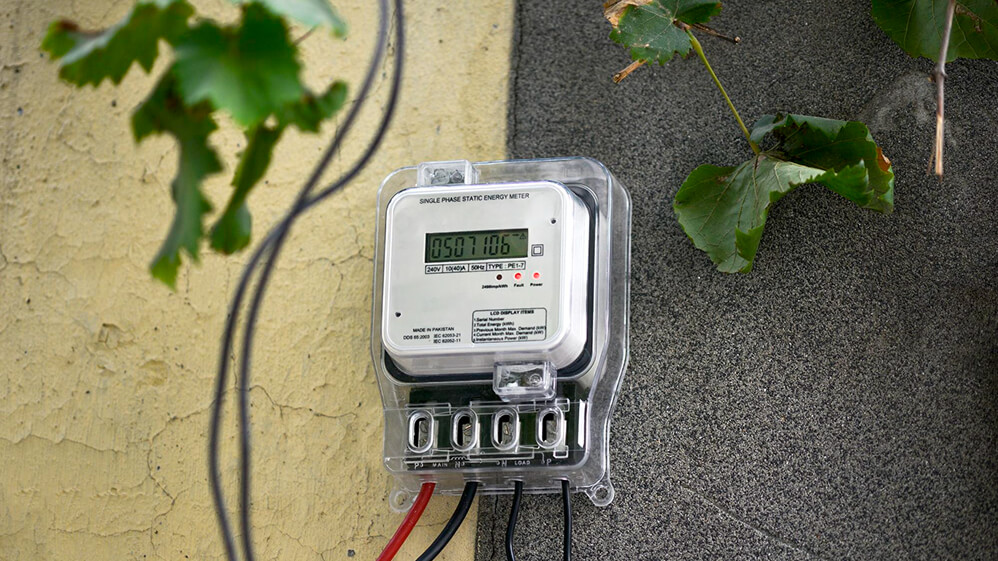
The 2023 amendment to the Rights of Consumers Rules sets a Time of Day tariff.
Solar-hour rates must be at least 20% below the normal tariff, and peak rates at least 1.10 times normal for most consumers (1.20 for commercial and industrial).
The adjustment applies to the energy charge.
What Changes With Demand-Based Billing?
Suppose a smart meter records maximum demand above your sanctioned load.
Now, the bill for that cycle will be calculated based on the recorded demand and not the sanctioned demand.
However, as a measure of complete transparency, you will receive SMS or discom notifications about the changes.
Rule 5, Sub-rules (5A) and (5B) of the Electricity (Rights of Consumers) Amendment Rules, 2023 govern this mandate.
According to the same mandate, no penalty can be imposed for the period before the smart meter was installed.
What About Smart Pre-Payment Meters?
Under Rule 5(1) of the 2020 Rules, all new connections and upgrades are systematically transitioned to smart pre-payment meters or pre-payment meters.
The same 2020 rules further strictly establish that a smart prepayment meter is strictly a payment mechanism, not a separate tariff category.
DISCOMs apply the same consumer category tariff rates (e.g., domestic, commercial) to prepayment balances as they do for regular postpaid billing cycles.
The rules forbid utilities from charging a premium per unit of electricity simply because the customer is on a prepaid system.
Moreover, according to Rule 7, the disconnection framework says that when a prepaid account balance hits zero, the meter is designed to automatically cut off the supply.
However, the rule explicitly specifies that this automatic shutdown shall not be treated as a formal disconnection.
How Can You Verify Your Own Bill?
You can verify your own electricity bill by pulling the tariff order for your category from the discom or SERC website.
Multiply units by slab rates, add the fixed charge and adjustments, then apply duty.
If the total differs by more than the rounding-off figure, you must raise a complaint with your discom.
What Are The Exact Steps At A Glance?
| Step | Action | Formula or Source |
|---|---|---|
| 1 | Note the units billed from the bill. | Current reading minus previous reading. |
| 2 | Find your tariff category and slabs. | SERC or DISCOM tariff order. |
| 3 | Compute energy charge. | Units in each slab × slab rate. |
| 4 | Add fixed or demand charge. | Sanctioned load × rate per kW. |
| 5 | Add fuel adjustment, duty, and other items. | As per tariff order and bill lines. |
| 6 | Subtract subsidy or rebate; compare totals. | Match the bill’s payable amount. |
Electricity Bill Calculation In India: Frequently Asked Questions (FAQs)
Here are the frequently asked questions and answers related to electricity bill calculation.
1. What Is One Unit Of Electricity?
One unit of electricity means one kilowatt-hour, or 1000 watts used for one hour.
So, you can follow an easy formula to calculate the units consumed.
Formula:
Units (kWh) = (Wattage of Appliance in Watts × Hours of Usage) / 1,000
Example:
Suppose you have run a 2,000-Watt geyser for 2 hours.
Units = (2,000×2)/1,000 = 4 units.
2. Why Do I Have To Still Pay An Electricity Bill Even If I Use No Electricity?
In India, you still receive an electricity bill with a non-zero balance even when your actual consumption is zero because of state-regulated Fixed Charges (Fixt/Demand Charge) and Meter Rent.
These are independent of your power usage.
Indian Distribution Companies (DISCOMs), such as MSEDCL, UPPCL, WBSEDCL, or BESCOM, structure your bill using two main pillars.
These are variable charges (per unit consumed) and fixed infrastructure maintenance costs.
3. What Is Sanctioned Load?
The sanctioned load is the maximum load approved for your connection, shown on your bill.
The sanctioned load is an important component when calculating the fixed rate.
Also, if a smart meter records energy usage for a period that is higher than the sanctioned load, it will record the actual consumption.
4. Who Approves Tariffs?
Electricity tariffs in India are approved and determined by independent Electricity Regulatory Commissions under the provisions of the Electricity Act, 2003.
State Electricity Regulatory Commissions (SERCs) fix and approve retail electricity tariffs for household, commercial, and industrial consumers within their respective states.
The calculation is based on proposals submitted by distribution companies (DISCOMs).
Furthermore, the Central Electricity Regulatory Commission (CERC) determines tariffs for stations owned by the central government.
Also, the Joint Electricity Regulatory Commissions (JERCs) determine the tariffs of union territories and participating states.
5. What Does The Fuel Adjustment Charge Change Every Month?
The fuel adjustment charge (FAC) changes monthly because the cost of fuel, such as coal, oil, and natural gas, used by power plants constantly fluctuates in the global market.
Electricity providers pass these rising or falling raw material and transportation costs directly to consumers rather than changing base electricity rates.
Consequently, your monthly bill adjusts dynamically based on the actual price the utility paid to generate power during that specific billing cycle.
6. Is Electricity Duty The Same In Every State?
No, the electricity duty is not the same in every state.
Electricity Duty varies by state because electricity is a concurrent subject under the Indian Constitution.
It allows each state government to set its own tax rates and structures.
7. Where Can I Find My Tariff Order?
You can find your official electricity tariff order directly from your state power distribution company (DISCOM) or state electricity regulatory commission portal.