

How Much Can A Running Toilet Increase A Water Bill In India? Know The Risks
Quick Answer
How much can a running toilet increase a water bill in India depends on the reason behind the running water.
A running toilet can add anywhere from about ₹30 a month for a worn flapper to nearly ₹30,000 for a stuck float valve.
Also, if the toilet is running constantly, it causes a wastage of around 750 liters of water every day. Again, sewer charges can often make your electricity bill shoot up.
In the 2017 movie, Toilet: Ek Prem Katha, the humble toilet became a national conversation. However, nobody has made a sequel about the cistern that hisses all night.
We probably don’t notice it because it does not flood a bathroom or trip an MCB.
It simply trickles into the drain when we see that we are paying thousands of rupees more than our average water bill for a 2-bedroom apartment.
So, if you are wondering why your water bill is so high, first check if you have a running toilet problem.
How Much Does A Running Toilet Leak Cost? A Quick Reference
| Leak Type | Approx. Flow Rate | Water Lost (30-Day Month) | Cost in Mumbai (BMC) (₹10–₹42/KL) | Delhi (DJB) (₹42–₹70/KL above 20 KL) | Bengaluru (BWSSB) (₹11–₹71/KL) |
|---|---|---|---|---|---|
| Phantom Flush/Slow Seepage (occasional cistern refill) | 0.035 L/min (50 L/day) | 1,500 L (1.5 KL) | ₹15 – ₹60 | ₹0*(if ≤20 KL) – ₹105 | ₹16 – ₹106 |
| Small Leak (worn flapper/outlet washer) | 0.08 L/min (115 L/day) | 3,450 L (3.45 KL) | ₹33 – ₹144 | ₹145 – ₹243 | ₹38 – ₹244 |
| Medium Leak (misaligned flapper/overflow) | 0.76 L/min (1,095 L/day) | 32,800 L (32.8 KL) | ₹315 – ₹1,365 | ₹1,384 – ₹2,306 | ₹359 – ₹2,323 |
| Large Leak (stuck float / fill valve) | 11.4 L/min (16,415 L/day) | 492,500 L (492.5 KL) | ₹4,728 – ₹20,488 | ₹20,774 – ₹34,618 | ₹5,393 – ₹34,874 |
How Much Water Does A Running Toilet Waste In An Indian Home?
The cost of a running toilet in India is more than we can imagine.
The Bureau of Indian Standards (BIS) Indian Standard IS 1172:1993 (Fourth Revision, Reaffirmed 2017), titled “Code of Basic Requirements for Water Supply, Drainage and Sanitation, has set standards for water supply, drainage and sanitation.
In its Clause 4.1, it specifies the supply of 150 to 200 litres per head per day (lphd) for communities with populations over 100,000 using full flushing systems.
It will be reduced to 135 litres per head for the low-income group (LIG) and economically weaker section (EWS) housing.
Furthermore, clause 4.1.1 allocates 45 litres per head per day specifically for flushing, with the remainder designated for other domestic needs.
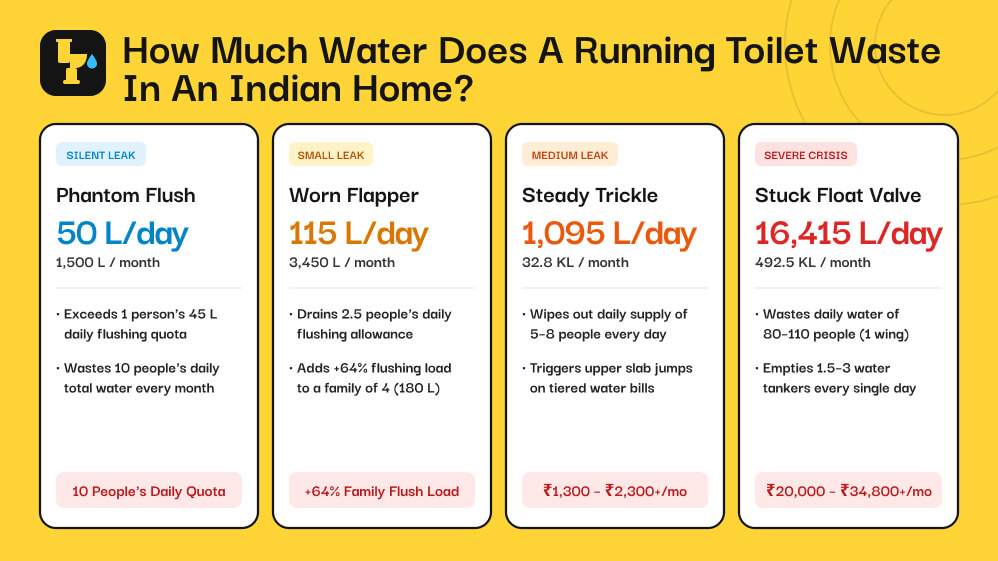
So, if a household is losing at least 1500 liters of water a month, it is wasting the daily allowance of around 10 people.
What Do The Leak Benchmarks Say?
So, how much can a running toilet increase a water bill?
The hidden impact of an Indian home goes far beyond a slightly higher water bill.
Even A “Silent” Leak Consumes An Entire Person’s Daily Allowance
Under IS 1172, as I have mentioned, a person should get a water supply of 150 to 200 liters of water per day.
However, just 45 liters per day is allocated for flushing. A seemingly harmless phantom flush wastes around 50 liters a day, and that is more than a person’s flushing quota for a day.
Also, when you calculate this daily wastage over a month, it comes to 1500 liters, the daily water requirements of around 10 people, as I have mentioned.
A Small Leak Doubles a Family’s Flushing Footprint
A small worn-flapper leak can cause the water loss of 115 liters per day, and that is 450 liters per month.
So, on average, it drains the daily flushing water of 2.5 people.
Now, suppose you have a standard family of four. According to IS 1172, your family is entitled to get 45 × 4 = 180 liters of water per day for flushing.
A single worn flapper leak will add 115 liters more to it, and that is around 63.89% more than the usual or prescribed daily amount for four persons.
A Medium Leak Wipes Out A Whole Household’s Daily Supply
A medium leak can wipe out 1095 liters of water every day, and that translates into 32,800 L/month.
In a day itself, the leak can waste the entire daily domestic needs of 5 to 7 people in average households and the requirements of 8 people in LIG/EWS housing.
In cities with tiered billing like Bengaluru, Delhi, or Mumbai, an extra 32.8 KL immediately pushes a household out of subsidized slabs into punitive upper slabs.
Thus, it can turn a ₹100 rubber part issue into a ₹1,300 to ₹2,300+ monthly bill shock.
A Stuck Float Valve Is a Building-Level Crisis
Losing 16,415 L/day (492.5 KL/month) is the equivalent of wasting the total daily water supply of 80 to 110 people.
So, on average, it wastes the water supply stipulated for roughly an entire apartment wing.
The consequence of this huge water loss is beyond the monetary cost of ₹20,000 to ₹34,800+ per month.
In areas dependent on borewells or private water tankers (which typically hold 5,000 to 10,000 litres), a single stuck toilet valve empties 1.5 to 3 full water tankers every day.
How Do You Turn Litres Into Rupees For Indian Water Bills?
If you want to figure out what a running toilet actually costs on your monthly bill, you have to translate wasted liters into the exact billing units Indian municipal boards use.
You will also have to factor in how slab jumps and surcharges amplify that cost.
Convert Liters Into Kiloliters (KL)
Indian water utilities bill in kilolitres (KL), where 1 KL = 1,000 litres.
So, divide your estimated monthly leak volume in litres by 1,000 (for example, 3,450 litres = 3.45 KL).
Account For Telescopic Slab Jumps
Most Indian water boards, including BWSSB, DJB, and BMC, use progressive (telescopic) slab tariffs.
In this, slab tariffs are where the per-KL price rises sharply as consumption crosses specific thresholds.
Even a moderate leak can push your total household usage out of a subsidized base slab (or out of Delhi’s 20 KL zero-bill threshold) into a much higher tier.
So, every leaked liter is billed at your highest marginal slab rate, not your average rate.
Add Sewerage And Sanitary Surcharges
Your base water tariff is not the final number you see on your electricity bill.
Most municipal boards tack on a mandatory sewerage or sanitary cess calculated as a percentage of your volumetric water charge.
The charge varies by state. For example, in Bengaluru, the charge is 25%, and in Mumbai and Delhi, the boards multiply the true cost of every wasted kiloliter by 1.25× to 1.60×.
Factor In Unmetered Or Society Billing Realities
To understand the real figures of how much a running toilet can increase a water bill, you have to understand the society billing realities.
Bulk Metered Apartments
Many gated communities split a single commercial or bulk domestic connection bill across flats, or charge residents a flat monthly maintenance fee.
While an individual leak may not show up on a personal municipal bill right away, it drives up overall society water expenses and tank-refill cycles.
Unmetered Cities And Tanker-Dependent Homes
In cities with flat residential water taxes (such as Kolkata under KMC) or homes relying on borewells and private tankers, wasted litres translate directly into higher submersible pump electricity bills or extra ₹800–₹2,500 private tanker orders.
The Quick Formula For Transforming Liters Into Rupees
Monthly Leak Cost (₹) = (Monthly Litres Wasted ÷ 1,000) × Your Highest Applicable Slab Rate (₹/KL) × (1 + Sewerage Surcharge %).
What If You Have No Water Meter?
Most Indian homes feel the leak differently.
A benchmark document from the Ministry of Housing and Urban Affairs recorded national consumption metering at 34.6 percent against a 100 percent target.
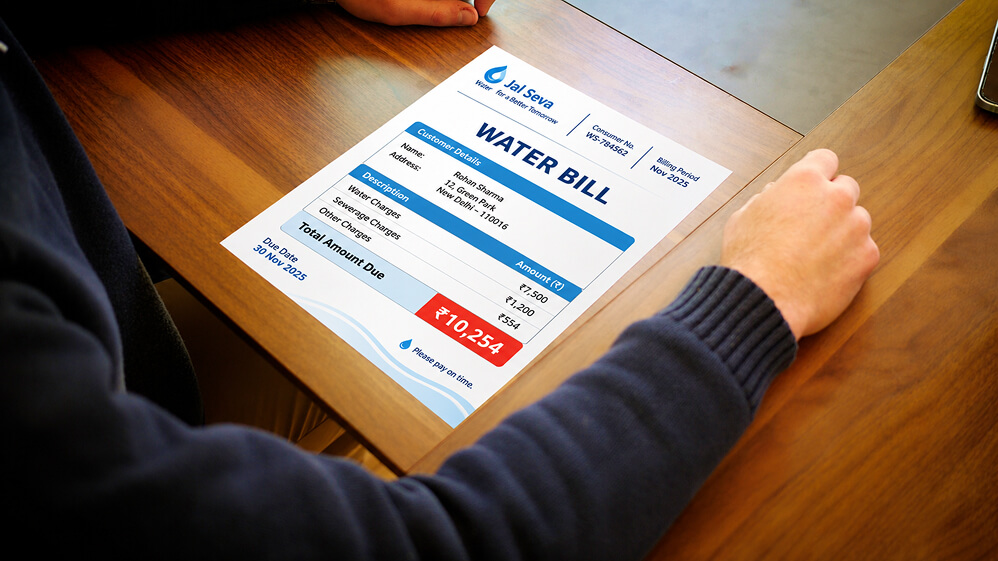
On a flat-rate connection, the bill stays flat, but you need to still bear the cost.
The overhead tank empties early, the motor runs longer, tanker orders increase, and the shortage reaches the top floor.
In apartments, a shared meter spreads one flat’s leak across everyone’s maintenance bill.
Why Does A Toilet Start Running In The First Place?
Mohenjo-daro’s homes had private bathrooms and covered drains some 4,500 years ago, yet they never had to debug a rubber flapper.
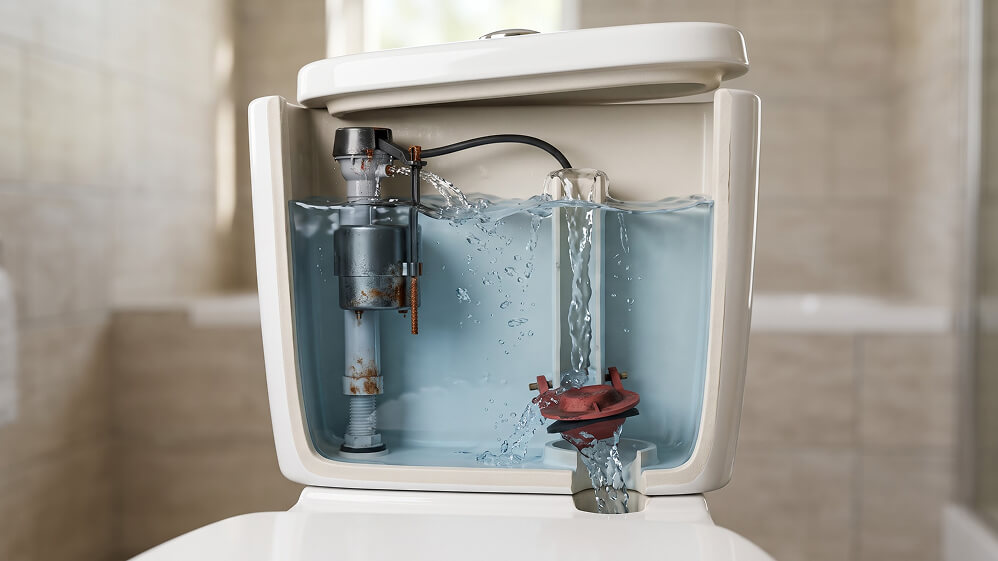
Today’s cistern is a simple machine: a valve fills it, a stopper holds the water, and an overflow pipe catches mistakes. Simple machines fail in simple ways.
Is A Worn Flush Valve Seal The Usual Suspect?
Usually, replacing a worn flush valve seal will eliminate the usual impact.
The rubber seal or flapper hardens and warps, and the water seeps into the pan. These leaks are silent, which is exactly why they survive for months.
What Happens When The Float Valve Fails?
If the float valve sticks or is set too high, water spills down the overflow pipe nonstop.
The EPA says a constantly running fill valve can waste between 0.5 and 3 gallons per minute. It is the nightmare scenario, though usually loud enough to notice.
How Can You Tell If Your Toilet Is Leaking?
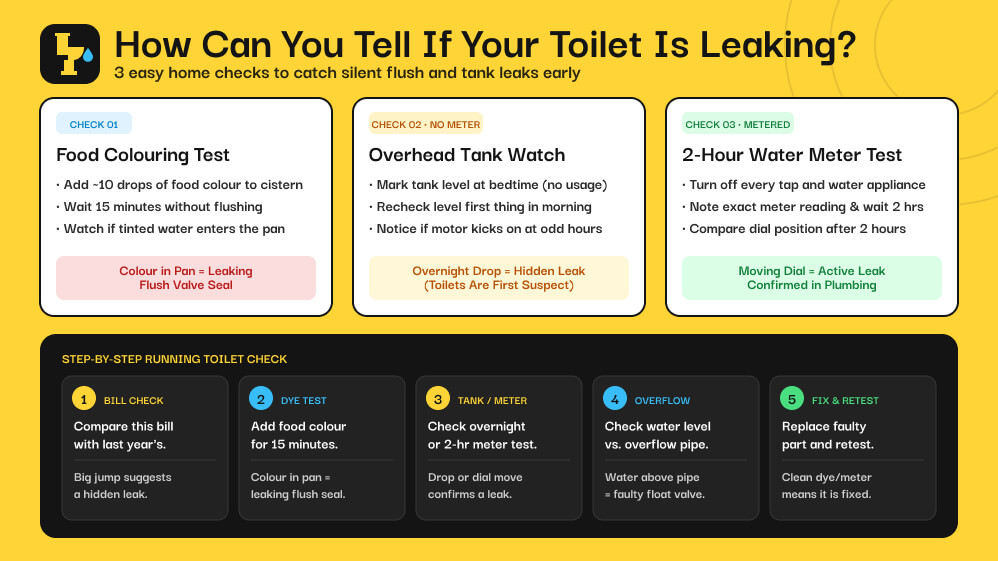
You can perform a set of three easy checks to find out whether your toilet is leaking or not.
How Does The Food Coloring Test Work?
Lift the cistern lid and add about 10 drops of food colour.
Wait 15 minutes without flushing. If colour reaches the pan, the flush valve seal is leaking.
How Can You Test Without A Meter?
Note the overhead tank level at bedtime and again in the morning with no use, or watch whether the pump switches on at odd hours.
An unexplained drop points to a leak somewhere, and toilets are the first suspect.
Can A Water Meter Catch A Leak?
Yes, a water meter can catch a leak.
Switch off every tap and appliance, record the reading, wait two hours, and read it again. If the dial moved, you have a leak.
Step-By-Step Running Toilet Check
| Step | What To Do | What It Means |
|---|---|---|
| 1 | Compare this bill with the same month last year. | A big jump suggests a hidden leak. |
| 2 | Add food colour to the cistern for 15 minutes. | Colour in the pan means a seal leak. |
| 3 | Check tank level overnight or run the two-hour meter test. | A drop or moving dial confirms a leak. |
| 4 | Check the cistern water level against the overflow pipe. | Water above the pipe points to the float valve. |
| 5 | Replace the faulty part and retest. | A clean result means it is fixed. |
How Do You Stop A Running Toilet From Draining Your Wallet?
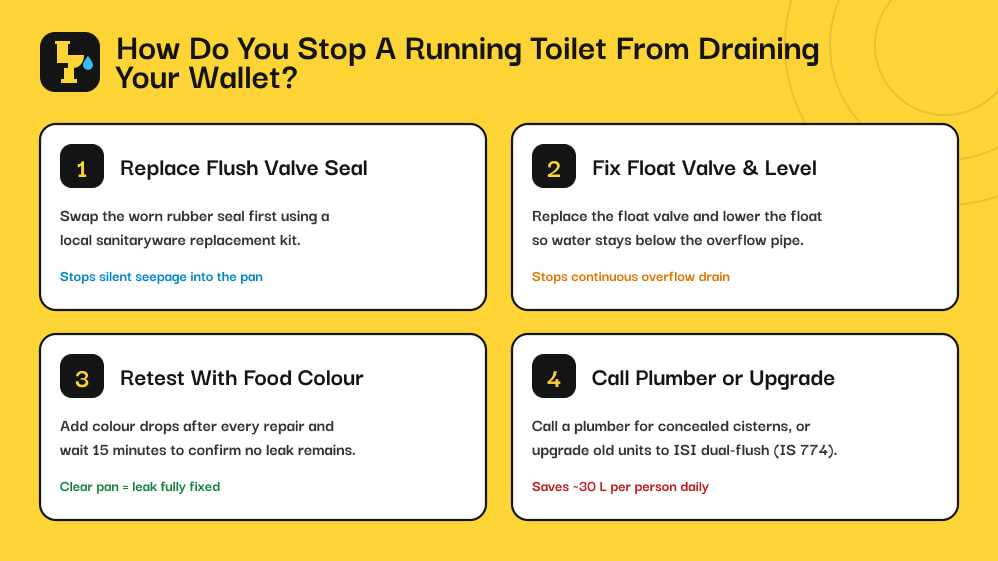
You can stop a running toilet from draining your wallet with easy checks and quick fixes.
Which Parts Should You Replace First?
Start with the flush valve seal, then the float valve, then lower the float so that the water sits below the overflow pipe.
Local sanitaryware shops sell replacement kits for common cisterns.
So, for a concealed wall-mounted cistern, call a plumber rather than breaking tiles. Also, retest with colors after every repair.
When Does Replacing The Whole Cistern Make Sense?
When the fittings are old, the leak is only half the problem. We all know that we have to buy ISI-marked equipment, but we miss these finer details.
IS 774:2021, the BIS standard for ceramic flushing cisterns, specifies dual-flush options of 6/3, 4.8/2.8 and 4/2 litres.
Also, a BIS circular records that the older 10/5 litre option was withdrawn.
Furthermore, here I must mention a written reply to a Lok Sabha question on May 7, 2015, by Sanwar Lal Jat, then Union Minister of State for Water Resources, River Development and Ganga Rejuvenation, which itself cited the Central Water Commission (CWC).
It noted that 6-litre toilets can save about 30 litres per person daily.
Final Thoughts: Is A Running Toilet Worth Ignoring?
No, if you understand how much can a running toilet access, a running toilet is not worth ignoring.
A worn seal costs a few rupees and an afternoon, while the leak it causes can cost thousands a year, and a stuck float valve can cost more in a month than the toilet is worth.
Run the checks this week, fix what they find, and keep the receipts.
Also, if a disputed bill is already overdue, pay it before it escalates.
Frequently Asked Questions About Running Toilets And Water Bills In India (FAQs)
Here are quick answers to what homeowners, tenants, and flat owners ask next.
Will My Water Board Reduce The Bill After A Leak Repair?
Yes, sometimes your water board can reduce the bill after a leak repair.
However, policies differ between boards. So, apply in writing at your local revenue or zonal office.
Attach the repair invoice, photos of the dye test or meter readings, and previous bills showing normal use.
Also, ask for a bill revision or instalments rather than just disputing the amount, and keep the acknowledgement.
Who Pays If I Am A Tenant?
Your rent agreement usually decides who pays the bill.
Minor fittings such as a flapper often fall on the tenant, while a failed concealed cistern may be the owner’s job.
Report the problem in writing with a date, and agree on who bears the water bill before repairs begin, as records protect you when a dispute arises.
How Does One Flat’s Leak Affect The Society Water Bill?
Many societies pay a bulk water bill and split it across flats. So, a single leak raises everyone’s charge.
Inform your resident welfare association or manager early. Some societies install sub-meters so that heavy wasters are visible and billed fairly.
Why Does My Toilet Refill Itself Every Few Minutes?
Your toilet refills itself every few minutes because of phantom flushing.
A slow seal leak lets cistern water seep into the pan until the level drops enough to trigger the float valve, which refills briefly.
It is a loud clue that the seal is failing, even when no water seems to be running.