

Can A Dripping Faucet Increase Your Water Bill? What A Leaking Tap Really Costs In India
Quick Answer
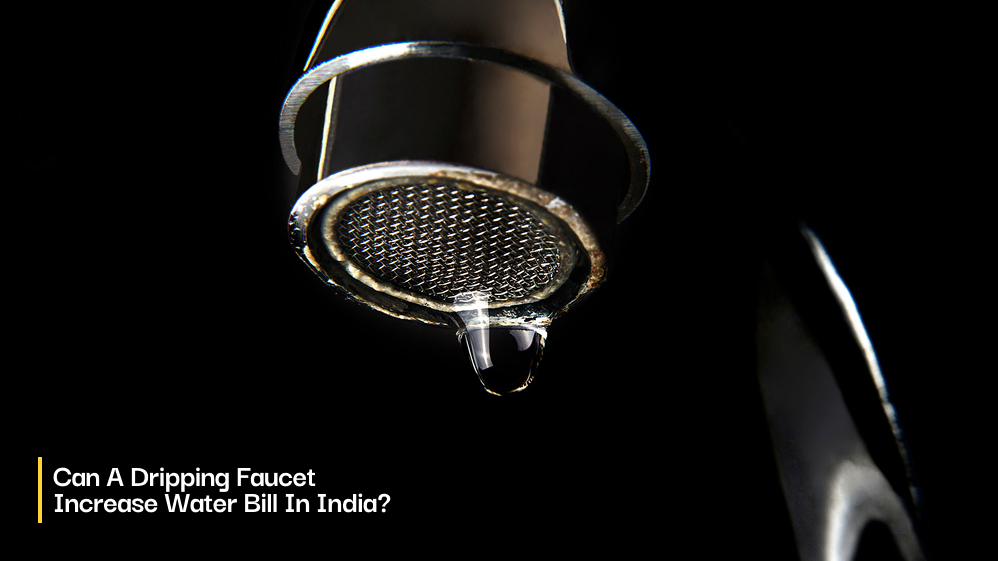
Yes, a dripping faucet in India can increase your water bill.
If you have a metered connection in India, every liter a dripping faucet wastes is included in your water bill.
Also, in Delhi, even a small leakage of water can push the water use in a household past the limit of 20000 liter of free usage.
Furthermore, Indian water boards estimate that a dripping tap can waste anywhere from 60 liters a week to a liter every hour.
Usually, the washer is the main problem for a dripping faucet, and fixing it usually costs between ₹100 and ₹400.
However, when you ignore it, the result is usually confusion about why your water bill is so high.
The impact of a dripping faucet on your wallet depends on three things.
- How fast it drips.
- Whether your connection is metered or not.
- How its local water board slabs its tariff.
We Indians have grown up with the proverb of “Boond Boond Se Ghada Bharta Hai,” meaning drop by drop fills the pot.
So, even a drop of wasted water matters, and if you have already fixed your running toilet and still the bill is high, it’s time to check the faucet.
How Much Water Wastage Can A Dripping Faucet Cause?
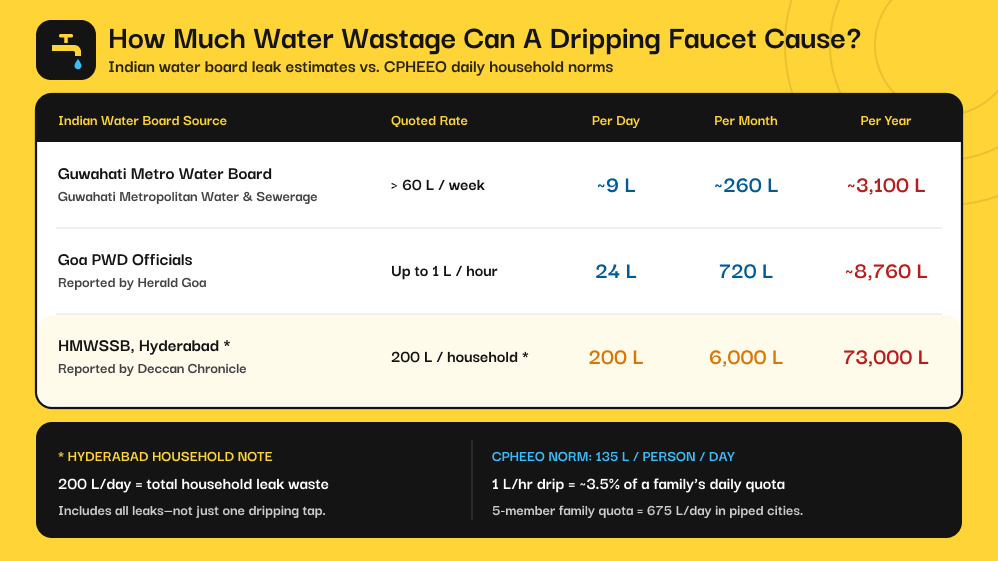
I could not find one national figure in India about how much wastage a dripping faucet causes.
No Indian authority has published one national figure, and the drip size varies with pressure and valve wear.
So, in the table below, I have quoted the estimate of water wastage as quoted by various water boards in India.
| Source | Estimate of Water Wastage | Water Wastage Per Day (Liters) | Water Wastage Per Month (Liters) | Water Wastage Per Year (Liters) |
|---|---|---|---|---|
| Guwahati Metropolitan Drinking Water and Sewerage Board | More than 60 Liters a Week | About 9 | About 260 | About 3,100 |
| Goa PWD Officials (As Reported by Herald Goa) | Up to 1 Liter an Hour | 24 | 720 | Around 8,760 |
| HMWSSB, Hyderabad (Reported by Deccan Chronicle) | 200 Liters Per Household | 200 | 6000 | 73,000 |
Here, you must note that the third row is for the entire household water wastage and not just for a dripping faucet.
Also, according to the Central Public Health and Environmental Engineering Organisation (CPHEEO) norm accepted by the Ministry of Housing and Urban Affairs, the water allocation is 135 liters per person per day for piped, sewered cities.
So, if you have a five-member family, the water allocation will be around 675 liters a day. Also, a tap leaking a liter an hour swallows about 3.5 percent of it.
How Much Can A Dripping Faucet Increase Your Bill? How Much Extra Do You Pay?
India has no single water tariff, and that is why the Delhi Jal Board, BMC, BWSSB, Chennai Metrowater, and HMWSSB bill water use differently.
Also, many households still pay a flat water bill charge.
Here, the Delhi Water Board sets an example by publishing a full schedule and billing formula.
What Happens If You Have A Metered Connection?
DJB’s schedule bills a domestic meter as P = M + 1.6BX.
Here, M is the service charge, B is the block rate per kiloliter, and X is the monthly consumption in Kiloliters.
Also, the 1.6 here is the 60 percent sewer maintenance charge.
DJB’s Citizen’s Charter lists the 20 to 30 kilolitre block at a service charge of Rs 219.62 and Rs 26.36 per kilolitre. So, an extra kiloliter would cost around ₹42.
At this rate, 0.72 kilolitres of water wastage a month adds roughly ₹30 monthly, about Rs 365 a year. Again, in Guwahati, it is around ₹11 a month or ₹ 132 a year.
Can A Dripping Faucet Make You Ineligible For A Free Water Allowance?
Yes, even a small drip can make you ineligible for a free water allowance.
DJB’s free water scheme covers metered domestic consumption only up to 20 kilolitres a month. So, if your family uses 19.5 kilolitres of water a month, you won’t have to pay anything.
However, even with a 0.72 kilolitre leak, the monthly consumption becomes 20.22 kilolitres, which is outside the scheme as it exceeds the 20 kilolitres slab by 0.22 kilolitres.
So, your water bill was 0. And now, suddenly, it is ₹1070. Check the step-by-step water bill calculation for better understanding.
| Charge Component | Formula/Rate | Amount |
|---|---|---|
| Base Water Charge | 20.22 kL×₹26.36 per kL | ₹533.00 |
| Sewer / Surcharge (60%) | ₹533.00 × 0.60 (making the total usage factor 1.6×) | ₹319.80 |
| Fixed Service Charge | Flat monthly meter/maintenance fee | ₹219.62 |
| Total Payable Bill | ₹533.00 + ₹319.80 + ₹219.62 | ₹1,072.42 |
You will get the washer for less than 100 rupees in India, and the labor charge for the job will be around ₹100 to ₹200.
So, when you ignore this, you invite an impact of thousands on your monthly budget.
What Happens If You Pay A Flat Rate Or Have No Meter?
A flat-rate connection will not show the drip on your bill, and DJB’s free scheme applies only to functional meters.
Yet the water is still wasted, and the Ministry of Urban Development’s pilot benchmarking found only 34.6 per cent of consumption metering nationally.
So, a sudden spike deserves a look at the plumbing fixtures before you blame the board.
What Hidden Costs Does A Dripping Tap Add?
There are certain hidden costs a dripping faucet can cause, even if these usually do not appear on the water bill.
Overhead tanks mean wasted electricity for pumping. A hot tap makes your geyser reheat water you never use. And if you buy tanker water, a leak costs far more than any board tariff.
The Delhi Water Board Act, 1998 also carries penalties for waste or misuse of water.
DJB told the National Green Tribunal that it recovered Rs 14.4 lakh in such penalties across 2017-18 and 2018-19.
Also, remember that a drip rate is the most misjudged number in household plumbing.
People watch a tap for ten seconds, call it harmless, and forget it runs twenty-four hours a day.
DJB’s own conservation advice is blunt. Plug all leaks immediately and have fittings checked periodically by qualified plumbers.
How Can You Confirm A Drip Is Costing You Money?
There is no scope for guesswork if you want to check whether a drip is costing you money or not.
| Steps | What to Do | What It Tells You |
|---|---|---|
| 1 | Switch off every tap and appliance, then note the meter reading. | Your baseline. |
| 2 | Wait two hours without using water and read the meter again. | Any movement means a leak somewhere. |
| 3 | Place a measuring jug under the dripping tap for ten minutes. | Drip volume. |
| 4 | Multiply the volume by 144. | Liters wasted per day. |
| 5 | Convert to kilolitres and apply your board’s formula. | Rupees lost per month. |
| 6 | Photograph the meter and jug with the date. | Evidence for any complaint. |
If you doubt the meter itself, DJB lets consumers request a test on payment of a fee, Rs 150 for a 15 mm domestic meter.
How Do You Fix A Dripping Faucet?
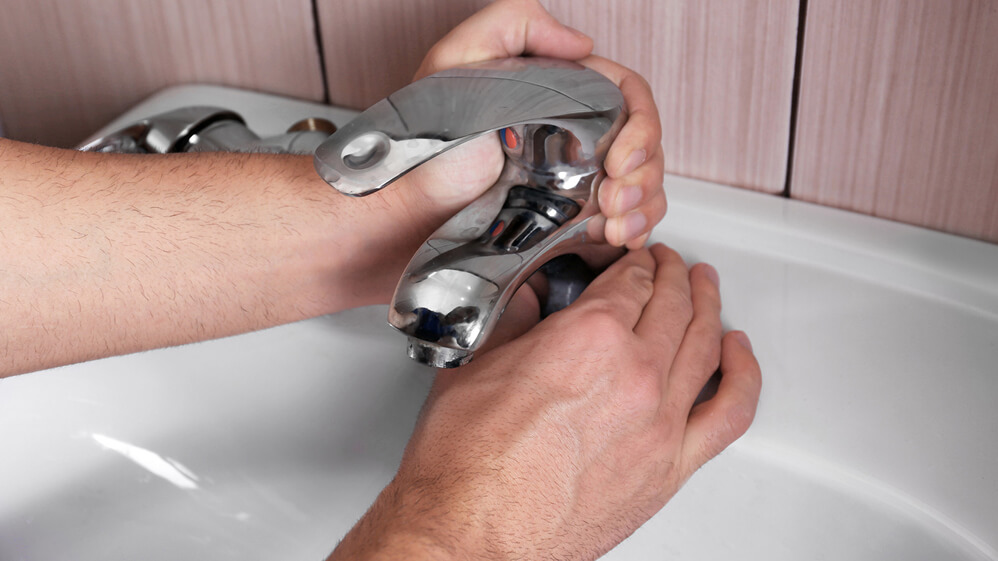
Most drips come from the part designed to wear out.
The Bureau of Indian Standards describes a screw-down bib tap in IS 781:1984 as one closed by a disc carrying a renewable non-metallic washer.
Renewable is the key word, meaning the washer is meant to be replaced.
Can You Fix It Yourself?
Yes, you can fix it yourself.
Close the isolation valve, open the tap to drain the line, then remove the handle and bonnet with a spanner.
Pull out the spindle, replace the washer with an exact match, clean mineral deposits from the seat, reassemble, and test.
However, single-lever mixers, covered by IS 8931:2021 along with pillar taps and combination assemblies, need a new cartridge rather than a washer.
When Should You Call A Plumber?
Call a plumber if the valve will not close, the spindle is corroded, or the tap sits on a concealed line.
A drip that returns within weeks usually means a pitted valve seat.
DJB advises ISI-marked fittings and qualified plumbers, and when buying a replacement tap, look for the BIS mark.
Why Does One Dripping Tap Matter Beyond Your Wallet?
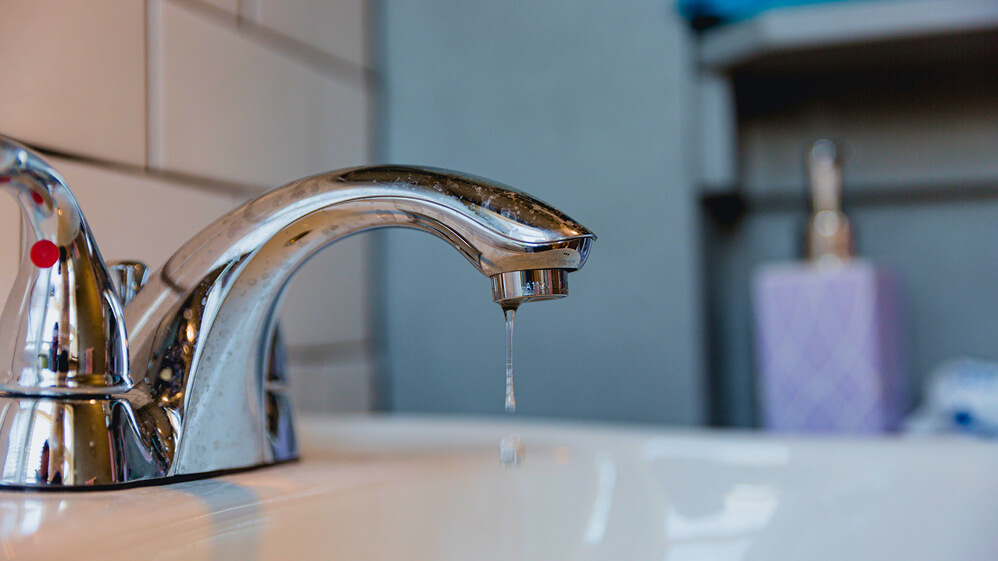
You think that a dripping faucet is a small plumbing problem in your house. However, think of it as a minuscule part of the national problem of water supply and scarcity.
The Ministry of Urban Development’s benchmarking found non-revenue water, meaning water produced but never billed, averaging 41.8 per cent against a 15 per cent target.
Also, rural households under the Jal Jeevan Mission are promised a minimum of just 55 litres per person per day, as the Press Information Bureau notes.
So, water wasted due to a dripping faucet or any other reason can create more crunch for water supply.
Moreover, if the bill suddenly increases and you ignore it or don’t pay it because all these years you have been paying a flat rate or 0, you must know the risks and what happens when you don’t pay your water bill.
Can A Dripping Faucet Increase Your Water Bill? Frequently Asked Questions (FAQs)
Here are the frequently asked questions and answers about a dripping faucet increasing your water bill.
Why Does My Tap Drip More At Night?
Water demand falls after midnight. So, pressure in the supply network rises.
A washer that holds comfortably during the day can leak under that extra pressure.
If a drip appears only at night, the washer is marginal and will probably start leaking all day soon. So, replace it before it worsens.
Is It Safe To Leave A Tap Dripping To Stop Pipes Freezing In Hill Stations?
In many places such as Srinagar, Leh, or Shimla, a thin trickle can keep water moving in exposed pipes during severe cold, and many residents do it.
However, you can insulate the pipes, as that is a cheaper option and it does not cause any water wastage.
Who Pays For A Dripping Tap In A Rented Flat Or Housing Society?
Who pays for a dripping tap in a rented flat depends on the rent agreement and the bye-laws of the specific society.
Usually, the tenant is responsible for minor repairs, while worn-out fixtures often fall to the landlord.
Does A Dripping Tap Cause Stains Or Damp?
Yes, a dripping faucet can cause stains or damp.
Constant dripping leaves limescale marks on basins and can darken grout, and a tap leaking inside a wall or cabinet may cause seepage, peeling paint, and mould.
Damp patches near a tap also suggest a hidden leak. So, call a plumber if you notice stains or dampness.
Can I Ask My Water Board To Review A Bill Inflated By A Leak?
You can always complain and ask your water board to review a dripping faucet.
DJB’s schedule says to lodge a written complaint with your Zonal Revenue Officer, take a diary receipt, and expect a final reply within 15 days.
Whether a leak earns any adjustment depends on your board’s policy. So, attach the repair receipt, photographs, and meter readings.
Should I Replace A Leaking Tap Or Repair It?
You should replace a leaking tap if it is old, heavily scaled, or corroded. Repairing such a faucet will be a waste of money.
For a fairly new tap with a worn washer, repair is enough. Also, when buying a new faucet, look for a ceramic cartridge model with a BIS mark.